- Free Case Evaluation: 312-779-6171 Tap Here To Call Us




Dog Bite Compensation After an Unleashed Dog Attack in Illinois


If you were injured in an unleashed dog attack in Illinois, you may be able to pursue dog bite compensation from the owner. Illinois law generally allows injured victims to seek damages for medical expenses, lost income, pain and suffering, scarring, and other losses when the legal requirements for liability are met.
Victims of an Animal Attack by Unleashed Dogs Have Rights
If you were injured by an unleashed dog in Illinois, you may be able to pursue dog bite compensation from the animal’s owner. Illinois law generally allows an injured person to seek damages when a dog attacks or injures someone who is peaceably in a place where they may lawfully be, provided the person did not provoke the dog. The amount available depends on the injuries, losses, liability, and available insurance coverage.
In 2025, insurers reported 28,450 dog bite and dog-related injury claims nationwide, with an average cost of $65,450 per claim. Illinois accounted for 1,283 claims with an average cost of $79,596. These figures include some injuries caused by dogs that were not bites, such as fractures or other blunt-force injuries, and they are not predictions of what any individual victim will recover.
In Illinois, many people are hurt each year when unleashed dogs attack them. Illinois law can impose liability on a dog owner even when the animal has no prior history of aggression.
A Chicago dog bite lawyer at our law firm can guide you through the claims process to fight for fair compensation if you have suffered from an unleashed dog attack in Illinois.
Critical Steps to Take After the Incident
If you want to pursue compensation for your losses, you must take the appropriate steps immediately following the incident:
- Seek medical attention to be diagnosed and treated for your injuries
- Report the incident to the local animal control agency and the police if necessary
- Identify the owner of the unleashed dog and obtain their contact and insurance information when possible
- Retain all medical records associated with your injuries
- Preserve photographs of your injuries, the location, damaged clothing, and other evidence from the attack
- Speak with an Illinois dog bite attorney if your injuries require medical treatment, leave scarring, or result in other significant losses
Following these steps can help protect your health and preserve evidence needed to evaluate an Illinois dog bite claim.
What Is the Average Dog Bite Settlement in Illinois?
No single average settlement predicts what an injured person will receive. However, 2025 insurance claim data provides useful context for understanding the amounts insurers paid on dog-related injury claims.
According to the Insurance Information Institute and State Farm, the average cost of a dog bite and related injury claim was $65,450 nationwide in 2025. Illinois had 1,283 reported claims with an average cost of $79,596 per claim. These are insurance claim figures, not guaranteed settlement amounts, and the dataset includes some non-bite dog-related injuries.
The firm’s published Illinois dog bite settlements also include examples of $400,000, $375,000, and $195,500 recoveries. These results are examples from specific cases and should not be treated as predictions or guarantees for another victim’s dog bite compensation.
The difference between individual results demonstrates why an average figure cannot determine the value of a particular claim. Injury severity, medical treatment, permanent scarring, lost income, insurance coverage, and other case-specific facts can all affect the amount involved.
Factors That Affect Your Dog Bite Settlement
A dog bite settlement depends on the evidence and losses associated with the individual claim rather than a fixed formula. Important factors can include:
- Injury severity: Deep punctures, nerve damage, fractures, infections, and injuries requiring surgery can result in greater medical and other losses.
- Permanent scarring or disfigurement: Visible scars, particularly facial scars, may affect both medical needs and non-economic damages.
- Victim’s age: Children may face years of growth, treatment, scarring, and psychological effects after a serious attack.
- Clarity of liability: Evidence showing where the attack occurred, who owned or controlled the dog, and whether the victim was peaceably present can affect the claim.
- Comparative fault: Illinois law provides that, in actions to which 735 ILCS 5/2-1116 applies, a plaintiff whose contributory fault is more than 50% may be barred from recovery, while damages may be reduced in proportion to fault when the plaintiff’s fault is 50% or less.
- Insurance coverage: The available dog bite insurance coverage through homeowners, renters, or other applicable policies can affect the funds available to resolve a claim.
- Lost income: Time away from work, reduced earning capacity, and other employment-related losses may be considered when supported by evidence.
Attorney review is recommended regarding how comparative fault applies to a particular Animal Control Act claim, because the firm’s existing blog content contains inconsistent statements on this issue.
How Dog Bite Compensation Is Calculated
Dog bite compensation generally involves documenting economic losses and evaluating non-economic harm. Economic losses can include medical expenses, rehabilitation, lost income, and other objectively documented costs. Non-economic damages may include pain and suffering, disfigurement, disability, emotional distress, and loss of enjoyment of life.
Rather than applying a guaranteed multiplier, an attorney can review medical records, wage documentation, photographs, treatment plans, and evidence of lasting effects to evaluate the damages supported by the claim.
Potential damages may include:
- Lost wages – If the dog bite forces you to miss work while recovering from injuries, you can seek lost income in the settlement
- Medical expenses – Costs associated with medical treatment for a dog bite, such as surgery, medication, or ongoing therapy, can be covered by the claim
- Emotional distress – An attack by an unleashed dog could lead to emotional health challenges, such as anxiety, depression, Post-Traumatic Stress Disorder, and a fear of other dogs
- Disability and disfigurement – An extremely severe dog bite may leave the victim with scarring or a permanent disability, which can influence the case value
- Pain and suffering – Injuries that cause significant physical pain can increase the non-economic losses assessed in your claim
- Loss of enjoyment of life – If the physical or emotional impact of the unleashed dog attack makes it harder to enjoy life, this can be considered a legal loss
Compensation When the Victim Is a Child
Dog bite injuries can have lasting effects on children because visible scars, reconstructive treatment, and emotional trauma may affect them as they grow. A child’s age, the location and permanence of the injury, future treatment needs, and psychological effects may be relevant when evaluating damages.
Settlements involving minors are subject to special legal procedures and may require court approval. Illinois courts have recognized that court approval of a settlement involving a minor’s claim is mandatory in appropriate circumstances. See our resources on children and dog bite injuries and facial scars from dog bites for more information.
How a Dog Owner Is Held Liable for Dog Bites
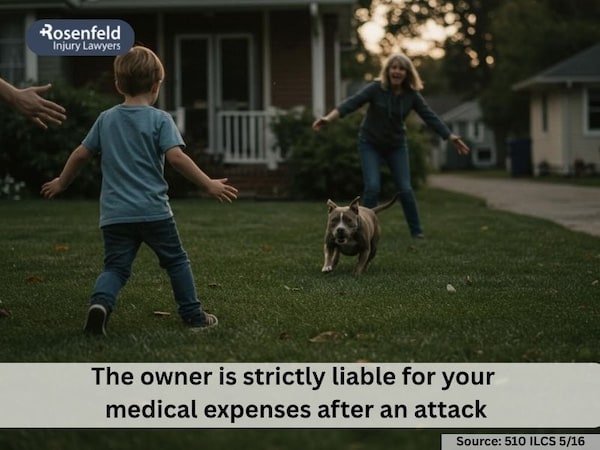
Under the Illinois Animal Control Act, 510 ILCS 5/16, a dog owner is liable for civil damages when a dog, without provocation, attacks, attempts to attack, or injures a person who is peaceably conducting themselves in a place where they may lawfully be.
The statute focuses on the circumstances of the attack rather than requiring proof that the dog previously bit someone. For more information about Illinois leash requirements and unleashed dog liability, see our guide to Illinois leash law and unleashed dog liability.
How Long Does a Dog Bite Settlement Take?
There is no fixed timeline for an Illinois dog bite settlement. The process typically begins with medical treatment and recovery, followed by documenting damages, making a settlement demand, negotiating with the insurer, and, when necessary, filing a lawsuit.
Many claims are evaluated once the victim’s medical condition is well understood, including whether additional treatment is needed. A demand can then be prepared using medical records, wage information, photographs, and other evidence. Negotiations may resolve the claim, but litigation can take longer if the parties cannot agree.
Illinois generally provides a two-year statute of limitations for personal injury actions under 735 ILCS 5/13-202, subject to exceptions. Minors and people under legal disability may be subject to different rules under 735 ILCS 5/13-211. Victims should obtain legal advice promptly rather than waiting until the deadline approaches.
Do not assume that the time needed to settle a claim extends the filing deadline.
Frequently Asked Questions
There is no guaranteed average settlement for an individual dog bite case. In 2025, the Insurance Information Institute and State Farm reported an average cost of $65,450 per dog bite and related injury claim nationwide and $79,596 across 1,283 Illinois claims. Those figures are insurance claim data, not predictions of an individual settlement.
Whether filing a lawsuit makes sense depends on the severity of the injury, available insurance coverage, liability evidence, damages, and whether the parties can reach a fair resolution without litigation. A legal consultation can help an injured person understand the available options before deciding whether to file suit.
There is no standard timeline. A claim may resolve after medical treatment and insurance negotiations, while a lawsuit can take substantially longer. The severity of the injuries, future treatment needs, evidence, insurance coverage, and the parties’ willingness to negotiate can all affect the timeline.
Generally, compensatory damages received on account of personal physical injuries or physical sickness are excluded from federal gross income under IRC §104(a)(2), subject to exceptions. The tax treatment can differ for certain portions of a settlement, including punitive damages or interest. Consult a tax professional about the specific settlement.
Potentially, yes, but the effect of your conduct depends on the applicable legal theory and facts. Under 735 ILCS 5/2-1116, when that statute applies, a plaintiff more than 50% at fault is barred from recovery, while damages may be reduced according to the plaintiff’s percentage of fault when the plaintiff is 50% or less at fault. Because Illinois dog bite claims can involve different legal issues concerning provocation and comparative fault, attorney review is recommended.
Contact Us for a Free Consultation About Your Case
If an unleashed dog caused you harm, you may have the right to seek dog bite compensation for documented medical expenses, lost income, pain and suffering, scarring, and other losses. Our Chicago dog bite injury lawyers can investigate the incident, gather evidence, and evaluate available insurance coverage.
Our legal services include:
- Investigating the incident
- Gathering evidence, such as witness statements, medical records, and dog vaccination records
- Assessing all legal damages
- Negotiating with insurance companies for a fair settlement supported by the evidence
- Litigating in civil court if a settlement cannot be reached
Our law firm operates on a contingency fee basis, meaning you owe nothing unless we secure a favorable outcome. Contact us today to schedule a free consultation with an attorney.
 Legally Reviewed By
Attorney Jonathan Rosenfeld
Content legally reviewed by Jonathan Rosenfeld The information on this page has been legally reviewed by Attorney Jonathan Rosenfeld, founder and managing partner of Rosenfeld Injury Lawyers LLC. With extensive experience representing dog bite victims across Chicago, Mr. Rosenfeld is dedicated to helping injury victims hold negligent dog owners accountable and pursue the maximum compensation available under the law. His deep legal knowledge and commitment to client advocacy ensure that the information provided is accurate, reliable, and aligned with current legal standards.