
Top-Rated Dog Bite Lawyers
Millions Recovered. Experienced Team. 24-7 Service



At Dog Bite Injury Lawyers, we know how devastating a dog attack can be: physically, emotionally, and financially. Illinois dog bite laws protect victims and establish when dog owners can be held liable for their animals’ attacks or injuries. If you’ve been bitten or attacked, you are not alone.
We stand with dog bite victims across the state, offering guidance, compassion, and legal support. Our mission is to make sure every victim understands their rights under the Illinois Animal Control Act and the protections available through Illinois courts. Understanding these laws can help you determine whether you may have a valid Illinois dog bite claim and what compensation may be available.

The foundation of Illinois dog bite law is the Illinois Animal Control Act (510 ILCS 5/). This statute was enacted to protect the public by regulating dog owners’ responsibilities and establishing clear rules for liability when an attack or bite occurs. For many injury claims, Section 16 of the Act is particularly important because it establishes statutory liability for qualifying animal attacks.
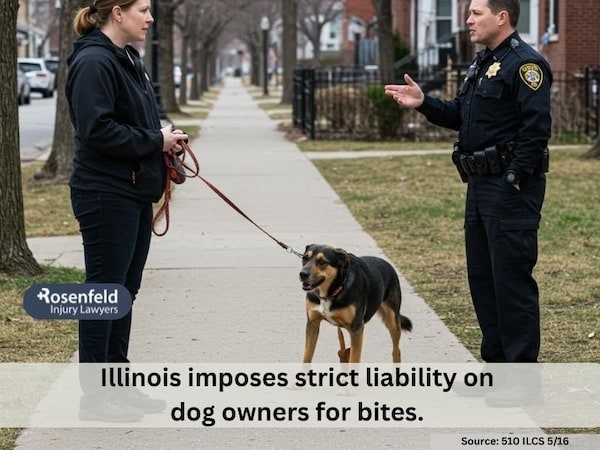
Unlike states that still follow a “one-bite rule,” Illinois is much stricter and imposes strict liability on owners whose animals cause harm, even if the dog has never bitten before.
Under this act, a person injured by a dog (or other animal) may pursue a claim if:
When these statutory requirements are satisfied, Section 16 provides that the owner is liable for the full amount of the injury proximately caused by the animal. We rely on this act every day to protect our clients and ensure they are not left alone with medical bills, lost income, or emotional trauma after a devastating dog bite or attack.
Illinois places clear responsibilities on dog owners. These rules are designed to protect the public from dog attacks and animal bites, while also holding owners accountable for the care and control of their pets. At Dog Bite Injury Lawyer, we often rely on these provisions when advocating for dog bite victims. These Illinois dog bite laws can also affect whether an owner faces additional consequences after an attack.
Under 510 ILCS 5/2.16, ownership is defined broadly. A person may be considered an owner if they purchased the dog, as well as if they harbor, care for, or knowingly allow the animal to remain on their property. The statute also includes people who have the animal in their care or act as its custodian. This ensures that responsibility cannot be easily avoided.
According to 510 ILCS 5/9, owners must prevent their dogs from running loose. Dogs found “running at large” may be impounded, and owners face fines and fees. Repeat violations can even result in mandatory sterilization. This requirement is central to preventing bites and protecting communities.
Section 510 ILCS 5/8 requires every dog four months or older to be vaccinated against rabies by a licensed veterinarian, with tags and certificates kept current. Owners are responsible for complying with applicable rabies vaccination and registration requirements.
Under 510 ILCS 5/12, an owner must report and confine any dog showing signs of rabies for at least ten days. This rule protects the public and ensures timely medical responses for bite victims.
In extreme cases, an owner may be labeled a “reckless dog owner” under 510 ILCS 5/2.18b if their dog kills another dog off property and the statutory requirements for a reckless dog owner determination are satisfied. Such owners may lose the right to keep dogs, and their animals can be forfeited. The Act provides for impoundment and forfeiture of dogs owned by a person determined to be a reckless dog owner, along with restrictions on future dog ownership.
Illinois law carefully distinguishes between dogs that may pose a risk to the public. The Illinois Animal Control Act outlines classifications for dangerous, potentially dangerous, and vicious dogs, each carrying specific restrictions and consequences for owners. These classifications are separate from a victim’s civil claim for injuries and can involve animal-control proceedings.
Under 510 ILCS 5/2.05a, a dog is considered dangerous when, under the circumstances specified by the statute, it poses a serious and unjustified imminent threat of serious physical injury or death, or when it bites a person without justification and does not cause serious physical injury.
Once a dog receives this designation, 510 ILCS 5/15.2 requires owners to keep the dangerous dog under control by a leash or other recognized control method when it leaves the owner’s premises.
The law also addresses potentially dangerous dogs. Under 510 ILCS 5/15.4, a dog found running at large and unsupervised with three or more other dogs may be deemed potentially dangerous by an animal control warden or administrator. The statute provides specific requirements, including spaying or neutering and microchipping.
According to 510 ILCS 5/2.19b, a dog may be declared vicious if it attacks without justification and causes serious injury or death, or if it continues to meet the statutory definition after prior dangerous-dog determinations.
Section 15 establishes the procedure for determining whether a dog is vicious and provides strict confinement requirements after a vicious-dog finding. Depending on the circumstances, violations can lead to impoundment, fines, and other consequences.
This act doesn’t just set standards for ownership, but also directly governs what happens when a dog bite or other animal attack occurs. These Illinois dog bite laws address both animal-control procedures and the civil liability that may arise from an attack.
Under 510 ILCS 5/13, whenever a dog or other animal bites a person, the animal is subject to statutory confinement and veterinary observation requirements once the appropriate animal-control authority receives information about the bite. The biting animal is then subject to a confinement period, typically ten days, to ensure it is observed for signs of rabies.
The statute also establishes specific responsibilities for an owner, agent, or caretaker of an animal documented to have bitten a person, including presenting the animal to a licensed veterinarian within 24 hours in circumstances covered by Section 13.
510 ILCS 5/16 imposes statutory liability on owners. This means that if a dog, without provocation, attacks or injures someone who is lawfully present in public spaces and acting peacefully, the owner is automatically responsible for damages.
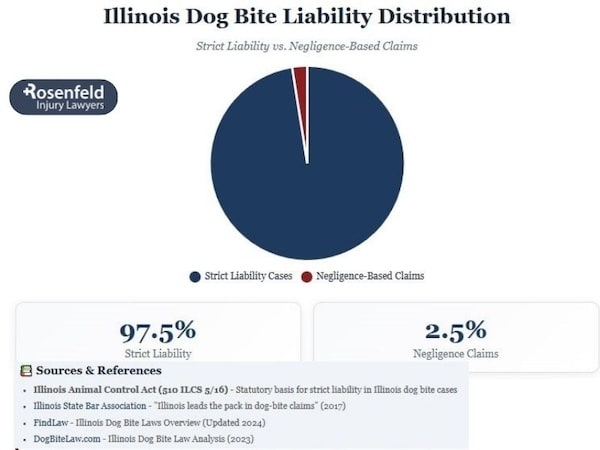
Unlike negligence-based systems, Illinois does not require the victim to prove that the owner knew the dog was dangerous or had acted carelessly. When the statutory elements are satisfied, the victim does not need to establish that the owner knew the dog was dangerous before the incident. Compensation may include medical bills, lost wages, pain and suffering, and emotional distress, depending on the circumstances of the claim.
While Section 16 creates statutory liability when its requirements are met, other parts of the Animal Control Act address broader liability issues. Local governments may also have animal-control ordinances that apply in addition to state law.
Case law further clarifies liability boundaries. In Docherty v. Sadler, the court dismissed a claim because the defendant did not meet the statutory definition of an “owner.” This case illustrates how crucial it is to establish ownership as defined by 510 ILCS 5/2.16. Illinois law defines “owner” broadly enough to include certain people who keep, harbor, care for, or act as custodians of an animal, but the specific facts determine whether a person falls within that definition.
In the context of dog bite cases, it is important to distinguish liability from negligence. Liability is automatic once the statutory requirements are satisfied, meaning the owner is held responsible even if they were otherwise careful. Under Section 16 of the Illinois Animal Control Act, a qualifying claim does not require proof that the owner knew the dog was dangerous or negligently failed to control it. Negligence, by contrast, requires showing that the owner breached a duty of care, such as failing to secure fencing or ignoring leash laws.
This distinction benefits dog bite victims because the law may provide a statutory cause of action under the Animal Control Act, while negligence theories may also apply depending on the facts. In either case, the law is designed to protect the victim rather than excuse the owner.
Even though the law provides strong protections for dog bite victims, there are strict time limits for filing a lawsuit. These limits, known as statutes of limitations, determine how long a dog bite victim has to take legal action in court.
According to 735 ILCS 5/13-202, dog bite victims in Illinois generally have two years from the date of the injury to file a personal injury lawsuit. This means an adult victim generally has two years from the day the bite occurred to file a lawsuit. Waiting beyond this deadline usually results in losing the right to pursue compensation, no matter how strong the case against potential defendants might be.
State law recognizes that minors may need more time. According to 735 ILCS 5/13-211, children who are bitten by a dog have until two years after their 18th birthday to file a claim. Section 13-211 generally provides that a person who was under 18 when the cause of action accrued may bring the action within two years after turning 18.
No. Illinois generally does not require a victim to show that the dog previously bit someone. Section 16 establishes statutory liability when its requirements are satisfied.
No. Illinois’ statutory definition of a dangerous or vicious dog is not based on breed. The Animal Control Act applies its classifications based on the dog’s conduct and the circumstances specified by the statute.
Yes, but it depends on the circumstances. Courts (see Steinberg v. Petta) have held that a landlord’s status as a property owner alone does not necessarily make the landlord an “owner” of a tenant’s dog under the Animal Control Act. The specific evidence concerning care, custody, control, or harboring is important.
Victims may recover compensation for physical injuries, scarring, infections, lost wages, loss of earning capacity, pain and suffering, and emotional trauma.
Yes. Compensation can be awarded for more than just physical pain, and depending on the claim and supporting evidence, victims may seek damages for emotional distress and other non-economic losses in addition to medical bills and lost income.
Payouts in Illinois dog bite cases vary widely depending on the severity of injuries, medical costs, and other damages. Rather than relying on an average settlement figure, victims should understand that the value of an individual case depends on factors such as the severity of the injury, treatment, scarring, lost income, pain and suffering, and available insurance coverage.
Most common defenses argue that the victim provoked the dog, trespassed, or was not behaving peacefully. The applicability of these defenses depends on the facts of the incident and the requirements of the Illinois Animal Control Act.
If you or a loved one has been injured in a dog bite or attack, our team is here to guide you through every step of the legal process. We can help by investigating the facts, dealing with insurance companies, and fighting to make sure your rights are protected under the law.
We offer free, confidential consultations, and we work on a contingency fee basis, meaning you never pay upfront costs and owe us nothing unless we recover compensation for you.
If you need help understanding Illinois dog bite laws or determining whether you have a claim, our attorneys can review the circumstances of your injury and explain your legal options.
Reach out today to learn how we can help you pursue justice after a serious dog bite.
 Legally Reviewed By
Attorney Jonathan Rosenfeld
Content legally reviewed by Jonathan Rosenfeld The information on this page has been legally reviewed by Attorney Jonathan Rosenfeld, founder and managing partner of Rosenfeld Injury Lawyers LLC. With extensive experience representing dog bite victims across Chicago, Mr. Rosenfeld is dedicated to helping injury victims hold negligent dog owners accountable and pursue the maximum compensation available under the law. His deep legal knowledge and commitment to client advocacy ensure that the information provided is accurate, reliable, and aligned with current legal standards.