- Free Case Evaluation: 312-779-6171 Tap Here To Call Us




Common Defenses Raised in Dog Bite Lawsuits


A dog bite defense may focus on provocation, trespassing, assumption of risk, ownership, causation, damages, or filing deadlines. In Illinois, the outcome depends on the facts, evidence, and legal theory involved. The Illinois Animal Control Act protects people who are peaceably conducting themselves where they may lawfully be.
What Is the Primary Law in an Illinois Dog Bite Lawsuit?
The Illinois Animal Control Act, 510 ILCS 5/16, provides that an owner is liable when a dog, without provocation, attacks, attempts to attack, or injures a person who is peaceably conducting themselves in a place where they may lawfully be. The statute permits recovery for the full amount of the injury approximately caused. For more information, see our Illinois dog bite laws page.
Because of this statute, a person bitten or attacked by a dog, whether at a park, in a yard, or at a private residence, can pursue a lawsuit even if the dog had no attack reports. This makes the Act a legal tool for victims of dog bites, mail carriers, delivery drivers, and other individuals with implied permission to be on a property.
What Are the Common Dog Bite Defenses in Illinois?
While Illinois law provides a statutory basis for dog bite claims, the owner may raise defenses involving provocation, lawful presence, assumption of risk, ownership, causation, damages, or the filing deadline.
Defense 1: Provocation
Provocation is central to an Illinois dog bite lawsuit. Illinois courts have held that an intentional act is not required in every case. In Nelson v. Lewis, 36 Ill. App. 3d 130 (1976), the court held that an unintentional act could constitute provocation when a child stepped or fell on a dog’s tail, and the dog responded without a vicious attack. Wade v. Rich, 249 Ill. App. 3d 581 (1993), later explained that when an unintentional act is followed by a vicious attack disproportionate to the act, provocation may not exist.
The circumstances, the nature of the act, and the dog’s response therefore matter. A child petting a dog, delivering mail, or approaching a property is not automatically the same as intentionally tormenting, striking, or abusing an animal. See what behavior is considered provoking a dog for more information.
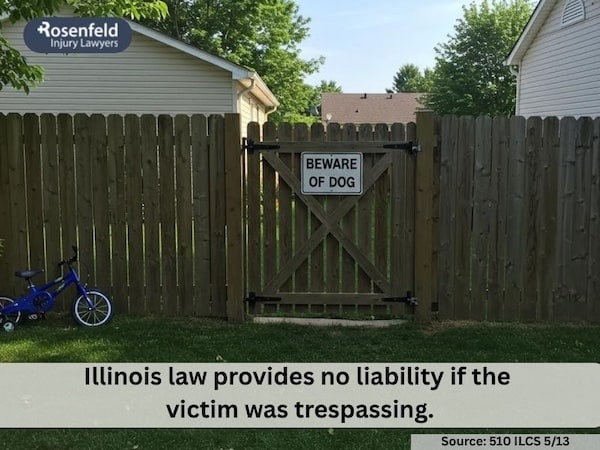
Defense 2: Trespassing
The second defense is that the injured individual was unlawfully on private property when the attack happened. In other words, the dog owner may not be held responsible if the victim was trespassing without permission.
But this defense is also limited. Under Illinois dog bite law, anyone who is lawfully present, including guests, postal workers, delivery drivers, meter readers, or others with implied permission, may be protected.
A dog bite lawsuit is still viable even if the victim was inside a fenced yard, on a driveway, or approaching a front porch, depending on whether the person had a legal right to be there.

Defense 3: Assumption of Risk
Assumption of risk can apply in limited circumstances when a person’s relationship with the animal means the person knowingly accepted a risk that the Animal Control Act was intended to address. In Harris v. Walker, 119 Ill. 2d 542 (1988), the Illinois Supreme Court held that a person who rented a horse, understood and expressly accepted the risks of horseback riding, was outside the class protected by Section 16.
Defense 4: “I’m Not the Owner” / Wrong Dog Defenses
Illinois law defines “owner” broadly. Under 510 ILCS 5/2.16, an owner can include a person who has a property right in an animal, keeps or harbors it, has it in their care, acts as its custodian, or knowingly permits a dog to remain on premises they occupy.
An owner may also dispute that their dog caused the injury. Evidence can include animal control bite reports, veterinary records, witness statements, photographs, video, and the dog’s observation records. Illinois law generally requires a biting animal to be confined for at least 10 days for observation, subject to statutory exceptions. See who counts as a dog’s owner for more information.
Defense 5: Causation and Damages Disputes
Insurers may dispute whether the dog attack caused all of the claimed injuries. They may point to pre-existing conditions, gaps in treatment, or other possible causes. Section 16 permits recovery for the “full amount of the injury approximately caused,” so medical records and treatment history can help connect the claimed damages to the attack.
Defense 6: Statute of Limitations
Illinois generally requires personal injury actions to be filed within two years after the cause of action accrues under 735 ILCS 5/13-202. For a person who was under 18 when the claim accrued, 735 ILCS 5/13-211 generally permits the action within two years after the person turns 18, subject to the statute’s provisions and other potential exceptions. A delay can therefore become a defense if the applicable deadline has expired. Review child-victim cases promptly because the limitations rules can differ from those applying to adults.
Defense 7: Negligence Theory / Comparative Fault
The current statement that comparative fault “does not apply” should not be published without attorney confirmation. Illinois appellate authority has addressed comparative fault differently depending on the legal theory and the Animal Control Act claim involved. The firm’s existing articles also contain conflicting statements on this issue.
Prior Knowledge or Aggressive Behavior Arguments
Suggesting the owner had no idea the dog was dangerous is generally not enough to defeat an Animal Control Act claim. The statute does not require proof that the owner knew about a dog’s aggressive nature before liability can arise when the statutory elements are established.
How Does a Dog Bite Lawsuit Work in Illinois?
A dog bite lawsuit generally moves from an insurance claim to formal litigation if the claim cannot be resolved. Defenses can arise during the insurance investigation, discovery, settlement negotiations, or trial.
- Insurance claim: Document and present the injury, dog, owner, and available evidence to the insurer.
- Filing suit: If the claim is disputed or cannot be resolved, a civil lawsuit may be filed before the applicable deadline.
- Discovery: The parties exchange evidence and investigate issues such as ownership, provocation, lawful presence, causation, and damages.
- Settlement or trial: The case may resolve through negotiation or proceed to trial if the parties do not reach an agreement.
Whether it is worth suing depends on the injury, evidence, damages, insurance coverage, applicable deadlines, and defenses. Proof may include medical records, photographs, witness statements, animal control records, video, and evidence showing where and why you were lawfully present. Learn more about whether you can sue for a dog bite in Chicago.
How Our Firm Investigates Dog Bite Defenses
Our team investigates the circumstances surrounding an Illinois dog bite claim by gathering witness statements, photographs, video, animal control records, bite reports, medical documents, and other evidence relevant to the defenses raised. The investigation can help establish lawful presence, address provocation allegations, identify the responsible owner or keeper, and connect the attack to claimed injuries.
Need Legal Help With a Dog Bite Defense?
If an insurer or dog owner is raising provocation, trespassing, ownership, or another defense, an Illinois dog bite lawyer can review the evidence and explain your options.
Contact our team for a free consultation at 312-779-6171.
FAQs
Dog owners may dispute provocation, lawful presence, ownership, causation, damages, assumption of risk, or the claim’s timeliness. Available defenses depend on the facts and legal theory involved. Evidence such as witness statements, animal control records, medical records, and property records can be important.
Medical records, photographs, witness statements, animal control reports, video, and records identifying the dog and owner may also help establish the claim and address defenses.
There is no single answer for every case. The decision can depend on the injury’s severity, medical expenses, lost income, available insurance, evidence, applicable deadlines, and the defenses raised. A case review can help identify the legal issues and potential evidence.
Yes. An owner may raise provocation even when the injured person is a child. Illinois cases recognize that an unintentional act can sometimes constitute provocation, while also recognizing that a vicious response may be disproportionate to an unintentional act.
It depends on the legal theory involved. The Illinois Animal Control Act and Illinois appellate decisions address provocation separately, and courts have litigated applying comparative fault to Animal Control Act claims. The firm’s existing dog bite content contains conflicting statements on this issue, so the reviewing attorney should confirm the firm’s position before this answer is published.
Contact Our Illinois Dog Bite Lawyers for a Free Consultation
If you or a loved one has been bitten by a dog in Illinois, especially if the dog owner or their insurer is trying to blame you, our team is ready to step in. We can investigate the circumstances, review the evidence, and explain your options under Illinois law.
Call 312-779-6171 for a free, no-obligation consultation. We’ll review your case, explain your options, and handle your claim at no cost unless we win.
Content reviewed by Chicago dog bite lawyer Jonathan Rosenfeld of Rosenfeld Injury Lawyers LLC.
This article is for general information and is not legal advice.
 Legally Reviewed By
Attorney Jonathan Rosenfeld
Content legally reviewed by Jonathan Rosenfeld The information on this page has been legally reviewed by Attorney Jonathan Rosenfeld, founder and managing partner of Rosenfeld Injury Lawyers LLC. With extensive experience representing dog bite victims across Chicago, Mr. Rosenfeld is dedicated to helping injury victims hold negligent dog owners accountable and pursue the maximum compensation available under the law. His deep legal knowledge and commitment to client advocacy ensure that the information provided is accurate, reliable, and aligned with current legal standards.