- Free Case Evaluation: 312-779-6171 Tap Here To Call Us




Dog Bite Lawsuit: How to Sue After a Dog Attack in Illinois


A dog bite lawsuit can help an injured person seek compensation when a dog attack causes physical, emotional, or financial harm. In Illinois, the law may hold a dog’s owner liable when the statutory requirements are met. Victims can pursue a claim by documenting their injuries, identifying responsible parties, and working through the insurance or court process
At Chicago Dog Bite Injury Lawyers, we stand with dog bite victims across Illinois. These cases involve more than medical bills. They can bring pain, emotional distress, and disruption to everyday life. Understanding your legal options can help you decide how to move forward after an attack.
What Is a Dog Bite Lawsuit?
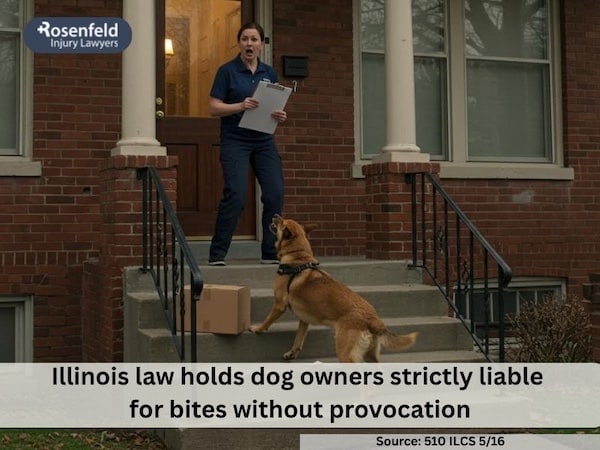
Illinois follows a statutory strict liability rule for many dog bite and animal injury cases. Under 510 ILCS 5/16 of the Illinois Animal Control Act, an animal’s owner may be liable when the animal, without provocation, attacks, attempts to attack, or injures a person who is acting peaceably in a place where they may lawfully be. A victim generally does not have to prove that the dog had bitten someone before or that the owner knew it might bite.
The law’s definition of an owner can extend beyond the person listed on a pet’s registration. Under 510 ILCS 5/2.16, the definition can include someone who keeps or harbors an animal, has it in their care, or acts as its custodian, depending on the circumstances.
Chicago also has local animal-control requirements. Under Chicago Municipal Code § 7-12-090, an animal’s owner must report a bite to the relevant authority within 24 hours and comply with applicable confinement and observation requirements.
A dog bite lawsuit is a civil claim for injuries and losses, not an animal-control investigation. A civil case may seek compensation for medical expenses, lost wages, pain, and other losses supported by the evidence. For a broader overview of Illinois dog bite laws, including owner liability and legal requirements, see our dedicated guide.
Can You Sue for a Dog Bite in Illinois?
Yes, you may be able to sue for a dog bite in Illinois if the facts satisfy the state’s legal requirements. The key questions include whether the animal caused an injury, whether you were lawfully present, whether you provoked the animal, and who legally qualifies as its owner or keeper.
You do not necessarily need a severe wound to have a potential claim. Punctures, infections, nerve damage, scarring, and psychological effects may all be relevant, depending on the evidence and the losses involved. A medical evaluation can help document the injury and identify treatment needs.
Whether suing makes sense depends on the harm you experienced, available evidence, insurance coverage, and the likely costs and benefits of pursuing a claim. A consultation can help clarify those factors without promising a particular result.
Who Can Be Sued After a Dog Attack?
The dog’s owner is often the primary person considered in a dog bite claim, but other parties may warrant investigation. Responsibility depends on the facts, the applicable law, and each person’s role in the incident.
| Potentially responsible party | When they may be relevant |
| Dog owner | The owner may be liable under the Illinois Animal Control Act when its requirements are met. |
| Dog walker or sitter | A person who had care or custody of the dog may fall within the statute’s definition of an owner, depending on the circumstances. |
| Landlord | A landlord may face a separate claim in certain circumstances, such as when the landlord knew of a dangerous condition and had the necessary control. Liability is not automatic. |
| Property owner or occupier | Their responsibility depends on control of the premises, knowledge of relevant risks, and the legal basis for the claim. |
| Parent of a minor dog owner | A parent is not automatically liable simply because their child owns the dog. The facts and applicable legal rules require review. |
A landlord is not automatically responsible for every attack involving a tenant’s dog. For more detail, see when a landlord can be sued for a tenant’s dog attack in Illinois.
Identifying every potentially responsible party early can help prevent important evidence from being overlooked. An attorney can assess ownership, custody, property control, and available insurance before determining whom to pursue.
How to File a Dog Bite Lawsuit, Step by Step
The process usually begins with medical care and evidence collection, then moves through insurance negotiations and, if necessary, a court case. The order and timing can vary with the injury, available evidence, and the parties’ responses.
- Get medical attention: Seek prompt treatment and follow your provider’s instructions. Medical records can document the injuries, treatment, and expected recovery. Never delay emergency care to collect evidence.
- Record what happened: If it is safe, photograph visible injuries, damaged clothing, and the location. Write down the date, time, address, and a description of the incident while your memory is fresh.
- Identify the dog and people involved: Collect the owner’s contact information, details about the dog’s caretaker, and witness names. Do not put yourself at risk to obtain information.
- Preserve relevant records: Keep medical bills, treatment notes, receipts, wage-loss information, photographs, and communications with the owner or insurer. Preserve original files where possible.
- Make any required report: Follow applicable animal-control and public-health instructions. Chicago’s reporting and observation rules are separate from the civil claim. For reporting-specific guidance, consult our guide to reporting a dog bite in Illinois.
- Consult a dog bite attorney: A lawyer can review liability, identify potential defendants, assess evidence, and check the filing deadline. The attorney may also communicate with insurers and help gather missing records.
- Notify the insurer and prepare a demand: Depending on the circumstances, you may file a claim with a homeowners, renters, or commercial insurer. Once the available evidence and damages are sufficiently documented, a demand letter may explain the legal basis and requested compensation.
- Negotiate or file in court: The parties may negotiate a settlement. If negotiations do not resolve the dispute, filing a lawsuit may be appropriate before the deadline expires. The court process can involve pleadings, evidence exchange, depositions, expert opinions, and motions.
- Resolve the case: A claim may settle before trial or proceed to a judge or jury. No settlement or trial outcome is guaranteed, and you should base your decision to accept an offer on the available evidence, losses, risks, and legal advice.
How Long Does a Dog Bite Lawsuit Take?
There is no fixed timeline for a dog bite lawsuit. A straightforward insurance claim may resolve sooner than a disputed case involving serious injuries, multiple parties, or a court trial.
| Stage | What typically happens |
| Initial consultation and investigation | The attorney reviews the facts, medical records, witnesses, and potential liability. |
| Medical treatment and documentation | The claimant receives treatment and gathers evidence of the injury and its effects. This may take longer when recovery is ongoing. |
| Insurance review and demand | The insurer evaluates liability and damages and may request supporting documents. |
| Negotiations | The parties exchange offers and may resolve the claim without filing suit. |
| Litigation and discovery | If a lawsuit is filed, the parties exchange evidence and may take depositions or obtain expert opinions. |
| Settlement or trial | The matter may settle during litigation or proceed to trial, depending on the circumstances. |
Cases involving disputed liability, substantial medical treatment, disagreements over damages, or scheduling delays may take longer. A lawyer can provide a more tailored estimate after reviewing the case, but any estimate remains subject to change.

What Does a Dog Bite Lawsuit Cost You?
The cost of pursuing a dog bite lawsuit depends on the attorney’s fee agreement and how the case proceeds. The firm should confirm its precise terms before this section is published.
If the firm handles the case on a contingency-fee basis, its attorney fee is generally calculated as an agreed portion of a recovery rather than billed as an hourly fee. The written agreement should explain the percentage, how case expenses are handled, and what happens if there is no recovery.
Before signing, ask:
- What percentage of a settlement or award will be charged as the attorney fee?
- Are filing fees, expert fees, medical-record charges, and other case expenses separate?
- Who is responsible for expenses if the case does not succeed?
- Does the fee arrangement change if the case proceeds to trial or appeal?
Do not assume that “no upfront attorney fee” automatically means that every possible expense is waived. Review the written agreement and ask the firm to explain any unclear terms. Clear fee information helps you assess the financial implications before deciding how to proceed.
How Long Do You Have to File a Dog Bite Lawsuit?
Illinois generally gives an injured person two years to file a personal injury lawsuit under 735 ILCS 5/13-202. Exceptions may apply, including special rules for minors under 735 ILCS 5/13-211.
The deadline can depend on the facts, the claimant’s age, and other legal considerations. Do not assume that negotiations with an insurer pause the filing deadline. Review how long you have to file a dog bite lawsuit in Illinois and seek advice promptly if you are unsure.
What Can You Recover in a Dog Bite Case?
Depending on the evidence and applicable law, a claim may include medical expenses, lost income, pain and suffering, emotional distress, and other losses caused by the injury. The amount depends on the individual facts, not simply the dog’s breed or the fact that a bite occurred.
For a fuller explanation of damages and valuation factors, see our guide to how much a dog bite case is worth in Illinois. No particular settlement amount or outcome can be guaranteed.
What Defenses Might the Dog Owner Raise?
An owner or insurer may dispute whether the legal requirements are met, whether the victim provoked the animal, whether the victim was lawfully present, or whether the claimed injuries resulted from the incident. The relevance of any defense depends on the evidence and applicable Illinois law.
For more detail, see our guide to common defenses in dog bite lawsuits.
Reporting a Dog Bite in Chicago
Reporting an attack can help address public-health concerns and create a record of the incident, but reporting is separate from filing a civil claim. Chicago Municipal Code § 7-12-090 sets out duties for the animal’s owner after a bite. For reporting steps and related guidance, see our dog bite reporting resource.
How Chicago Dog Bite Injury Lawyers Can Help
Our law firm supports people injured by dogs in Chicago and throughout Illinois. We can review the incident, gather relevant records, identify potentially responsible parties, and communicate with insurance companies.
Our work may include:
- Investigating the incident and collecting photographs, witness accounts, and available animal-control records.
- Reviewing liability under the Illinois Animal Control Act and assessing whether other parties may be responsible.
- Documenting losses, including medical expenses, lost income, and how the injury affects daily life.
- Handling communications with insurers and evaluating settlement proposals.
- Preparing for litigation when negotiations do not resolve the claim and filing suit is appropriate.
The right next step depends on your injuries, evidence, and circumstances. A consultation can help you understand the available options and the questions that need further investigation.

FAQs
It may be worth pursuing a claim when the injury has caused meaningful medical, financial, or personal harm and the evidence supports liability. The decision depends on the circumstances, likely damages, available insurance, and the costs and risks of pursuing the case. For help assessing the threshold question, see how bad a dog bite has to be to sue.
No single average reliably predicts what an individual case will recover. Outcomes depend on injury severity, treatment, lasting effects, lost income, liability evidence, and insurance coverage. For a closer look at valuation factors, see our guide to dog bite case values in Illinois.
The cost depends on the fee agreement. If a firm accepts a case on a contingency-fee basis, the attorney fee is generally tied to a recovery. Ask how expenses are handled and review the written agreement before signing.
No settlement amount is right for every case. The assessment should consider medical costs, lost income, pain, emotional effects, future treatment, liability evidence, and available coverage. A lawyer can evaluate the records and explain the strengths and uncertainties of a proposed settlement.
Yes, Illinois’s Animal Control Act generally does not require a previous bite for a claim. The statute focuses on whether the animal attacked, attempted to attack, or injured someone without provocation while the person was lawfully present. The facts must still satisfy the legal requirements.
No. Illinois does not generally require proof of a previous bite under the Animal Control Act. Liability instead depends on the statutory conditions and evidence surrounding the incident.
A dog owner’s homeowners or renters insurance may cover eligible claims, subject to the policy’s terms and exclusions. Commercial coverage or another party’s insurance may be relevant in some cases. Coverage is not automatic, so the policy and circumstances must be reviewed.
Yes, a family relationship does not automatically prevent an injured person from pursuing a claim. Insurance may be involved, but coverage depends on the policy and circumstances. Consider the personal implications and obtain advice before deciding how to proceed.
Illinois law imposes specific requirements for animals classified as dangerous or potentially dangerous, but breed alone does not determine civil liability under the Animal Control Act. Read our guide to most dangerous dog breeds for more context.
No, a bite does not automatically mean a dog will be euthanized. The response depends on the circumstances and applicable animal-control rules. See our guide on whether a dog will be put down after a bite is reported.
Contact Us About Your Dog Bite Claim
If a dog attack has injured you or someone in your family, Chicago Dog Bite Injury Lawyers can review your situation and explain your options. Our team can help you understand the evidence, potential liability, filing deadlines, and insurance process.
Contact the firm to ask about a free consultation and its fee arrangement. Before proceeding, review the written agreement so you understand attorney fees and case expenses. Seeking guidance early can help you protect important records and make informed decisions about your next steps.
This article is for general information and is not legal advice.
 Legally Reviewed By
Attorney Jonathan Rosenfeld
Content legally reviewed by Jonathan Rosenfeld The information on this page has been legally reviewed by Attorney Jonathan Rosenfeld, founder and managing partner of Rosenfeld Injury Lawyers LLC. With extensive experience representing dog bite victims across Chicago, Mr. Rosenfeld is dedicated to helping injury victims hold negligent dog owners accountable and pursue the maximum compensation available under the law. His deep legal knowledge and commitment to client advocacy ensure that the information provided is accurate, reliable, and aligned with current legal standards.