- Free Case Evaluation: 312-779-6171 Tap Here To Call Us




Landlord Liability for Tenant’s Dog Bite in Illinois: When Can You Sue?


Usually the tenant is liable. A landlord is liable only if it knew the dog was dangerous and could have acted, or the attack happened in a common area it controls. In Illinois, landlord liability for tenant’s dog bite usually rests on negligence, so what the landlord knew matters most.
The Tenant Is Usually Liable for Their Dog’s Actions
In most cases, the tenant who owns the dog pays for the injuries it causes. The Illinois Animal Control Act makes the owner of any dog liable when it attacks, attempts to attack, or injures someone who is acting peaceably where they have a legal right to be, without provoking the dog (510 ILCS 5/16). This holds even on the landlord’s property.
But in some cases, the landlord shares liability. Our guide on who is liable for a dog bite in Illinois covers every party who may share the blame.
If a tenant’s dog bit you or your child in Chicago, a Chicago dog bite lawyer can check whether the landlord shares responsibility.

Is a Landlord an “Owner” Under the Illinois Animal Control Act?
Usually not, unless the landlord lives there or helps care for the dog. Under 510 ILCS 5/2.16, an owner includes anyone who “keeps or harbors” a dog, has it in their care, or “knowingly permits a dog to remain on any premises occupied by him or her.”
A landlord who does not live in the unit usually falls outside strict liability. That means the claim is usually negligence or premises liability under the Illinois Premises Liability Act, 740 ILCS 130.
“Harboring” is the exception to watch. A landlord who feeds the dog, walks it, or controls it may qualify as an owner. A resident landlord who allows the dog faces risks like homeowner liability for dog bites. See our overview of Illinois dog bite laws.
Can You Sue a Landlord for a Tenant’s Dog Bite in Illinois?
Yes, in some cases. Landlord liability dog bite Illinois claims generally depend on whether the landlord knew about the danger, had the ability to act, and failed to take reasonable action. You generally must prove the landlord was negligent: it knew about the danger, could have fixed it, and did not.
It must be proven that the landlord took an unreasonable risk by allowing the dangerous dog to remain on the premises. If the landlord did not know the tenant had a dog, it generally cannot be held responsible.
Did the Landlord Have “Actual Knowledge” of the Danger?
Generally, the landlord must have known that the specific dog posed a danger, not simply that a tenant kept a dog on the property. This type of knowledge is often described as actual notice. The facts must show that the landlord knew, or had information indicating, that the dog had dangerous or aggressive tendencies.
Knowledge may come from prior complaints by fellow tenants, police reports involving the dog, previous incidents, or the landlord personally witnessing aggressive behavior. For example, repeated complaints that a tenant’s dog had attempted to bite someone or acted aggressively in a shared area could be relevant to whether the landlord knew about the risk. Simply knowing that a tenant owns a dog generally does not establish that the landlord knew the dog was dangerous.
Could the Landlord Have Removed the Dog?
Knowledge alone is not enough. The landlord must also have had the power to act, and the lease usually decides that. Many leases include pet, leash, or aggression clauses. These can require dogs to be leashed in shared areas or allow removal of an aggressive animal.
If the lease gives the landlord that right, it can demand the dog be removed or move to end the tenancy. A month-to-month tenancy can generally be ended with written notice. A fixed-term lease usually requires a lease violation first.
Assistance animals are different. Federal fair housing law limits a landlord’s ability to remove a service or support animal. But a landlord can generally act when that specific animal poses a direct threat based on its own behavior.
Liability for Dog Bite Injuries in Common Areas of a Property
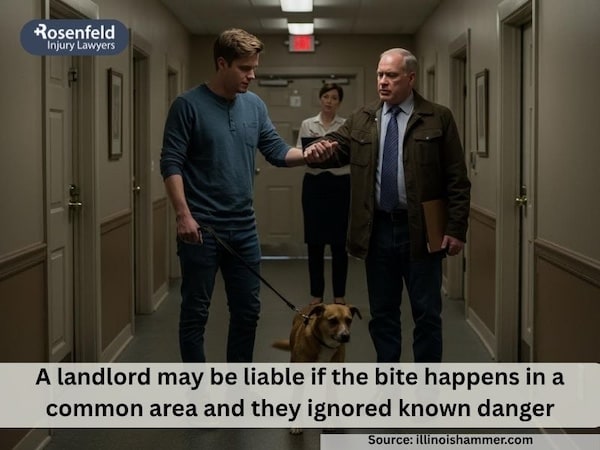
Landlords are more likely to be liable when a bite happens in a hallway, lobby, or shared yard. Landlords have direct control over common areas, such as hallways, courtyards, lobbies, stairwells, and parking lots. Courts may hold both the landlord and the dog’s owner liable for bites there.
For example, the landlord could be liable if they did not require leashes in shared areas or allowed pets to roam freely. Bites inside a tenant’s own unit are harder to pin on the landlord, since it has less control there.
Attacks Off the Rental Property
A landlord may also be liable when a tenant’s dog escapes the rental property and bites someone on a sidewalk, neighbor’s lawn, or another area outside the rental property. The key question is how the dog escaped and whether the landlord had responsibility for the condition that allowed it to get out. If the dog slipped through a broken fence, a gate that would not latch, or a damaged door that the landlord had been told to repair, the landlord’s failure to address the problem may have contributed to the attack.
Evidence showing that the landlord knew about the problem can be important. Repair requests, maintenance records, emails, text messages, inspection records, and photographs may help establish whether the landlord knew about the condition and had an opportunity to correct it. In our experience handling Chicago dog bite cases, repair records may be important evidence when determining whether a landlord failed to address a known property hazard.
Whose Insurance Pays: Tenant’s Renters Policy vs. Landlord’s Liability Policy
The tenant’s renters policy usually pays first. The landlord’s policy comes into play only when the landlord shares fault. Renters and homeowners policies typically cover dog bite liability up to $100,000 to $300,000, according to the Insurance Information Institute. In 2025, Illinois dog bite claims averaged $79,596.
| Coverage | When it pays | Common gaps |
| Tenant’s renters policy | The tenant’s dog caused the injury | Breed exclusions, prior-bite exclusions, no policy |
| Landlord’s liability policy | The landlord was negligent | Does not cover the tenant’s own fault |
| Umbrella policy | Damages exceed the primary limit | Only if one was bought |
When the tenant’s coverage falls short, a landlord claim may be the only way to cover medical bills and lost wages.
Hurt by a tenant’s dog at a Chicago rental property? Call 312-779-6171 for a free consultation. We work on a contingency fee basis, meaning that you owe us nothing unless we recover damages.
How We Investigate Landlord Liability for a Tenant’s Dog Bite
We look for proof that the landlord knew about the dog, had the power to act, and failed to. We interview tenants and neighbors, and review the lease, the dog’s history, and prior complaints.
The Animal Control Act says vicious dogs “shall not be classified in a manner that is specific as to breed” (510 ILCS 5/15(a)). Section 5/24 also bars breed-specific local rules.
A dog does not have to injure someone first to be labeled dangerous. Under 510 ILCS 5/2.05a, threatening behavior alone can qualify.
Excuses such as self-defense, pain, or protecting puppies apply when officials decide whether a dog is dangerous or vicious (510 ILCS 5/15 and 5/15.1). They are not defenses to a civil injury claim.
What to Do If a Tenant’s Dog Bit You at a Rental Property
Get medical care first, then preserve evidence about the dog and the landlord before it disappears.
- Report the bite to animal control. In Chicago, call 311.
- Write down the building address, unit number, and property management company.
- Save any prior complaints, texts, or emails you or others sent the landlord about the dog.
- Get witness names and phone numbers, including other tenants.
- Photograph your injuries and any broken gates, fences, or doors.
- Mind the deadline. You generally have two years to file under 735 ILCS 5/13-202. For minors, the deadline is generally two years after turning 18 (735 ILCS 5/13-211).
Examples of Our Dog Bite Injury Settlements
Examples of past results from our published Illinois dog bite settlements. Past results do not guarantee a future outcome.
$1,200,000: A toddler attacked by a relative’s Doberman at a Crystal Lake apartment building suffered facial scarring.
$700,000: A four-year-old was cornered by two dogs at a River North rental, causing nerve damage and scarring. The landlord knew the dogs had already injured other tenants.
$375,000: A three-year-old attacked by a pit bull in a Gold Coast apartment complex was left with permanent facial scars.
How Our Chicago Team Handles Landlord Dog Bite Cases
Our dog bite attorneys are members of the Million Dollar Advocates Forum and the Illinois Trial Lawyers Association. We handle cases at the negotiation table and, when needed, in the Cook County Circuit Court.
FAQs
Yes a landlord can be held responsible if a tenant’s dog bite in Illinois, but only in limited cases. The landlord generally must have known the dog was dangerous and had the power to remove it or prevent the attack. Otherwise, the tenant who owns the dog is usually the only one responsible.
Usually the dog owner pays for the dog bite claim, through their renters insurance. The landlord’s liability insurer pays only if the landlord shares fault. When the tenant has no policy, or a policy excludes the dog, a landlord claim may be the only real source of payment.
Usually a landlord doesn’t inspect for the dangerous dogs. Illinois does not generally require landlords to inspect tenants’ dogs. The duty starts when the landlord learns a specific dog is dangerous, such as through complaints or a prior bite. After that, ignoring the problem can create liability.
Often, yes. If the lease has a pet or aggression clause, a bite can count as a lease violation. The landlord must still follow Illinois eviction procedures. Assistance animals have extra protections, but one that poses a direct threat can generally be removed.
The landlord’s liability is more likely. Landlords control common areas and must keep them reasonably safe. If the landlord knew about the dog and did nothing, such as ignoring a leash rule, both the landlord and the owner may be liable.
Schedule a Free Consultation to Discuss Your Dog Bite Case
A tenant’s dog bite can leave you with medical bills and questions about who should pay. Dog owners are always responsible for their pet’s behavior, but others may also be held liable for a dog attack, including landlords. Call 312-779-6171 to schedule a free consultation. We work on a contingency fee basis, meaning that you owe us nothing unless we recover damages. We serve clients throughout Chicago, Cook County, and Illinois as a whole.
This article is for general information and is not legal advice.
 Legally Reviewed By
Attorney Jonathan Rosenfeld
Content legally reviewed by Jonathan Rosenfeld The information on this page has been legally reviewed by Attorney Jonathan Rosenfeld, founder and managing partner of Rosenfeld Injury Lawyers LLC. With extensive experience representing dog bite victims across Chicago, Mr. Rosenfeld is dedicated to helping injury victims hold negligent dog owners accountable and pursue the maximum compensation available under the law. His deep legal knowledge and commitment to client advocacy ensure that the information provided is accurate, reliable, and aligned with current legal standards.