- Free Case Evaluation: 312-779-6171 Tap Here To Call Us




How Many Children Are Bitten by Dogs Each Year? Latest U.S. Statistics


Last updated: September 24, 2026 Written by the Rosenfeld Injury Lawyers LLC Team | Reviewed by Jonathan Rosenfeld,
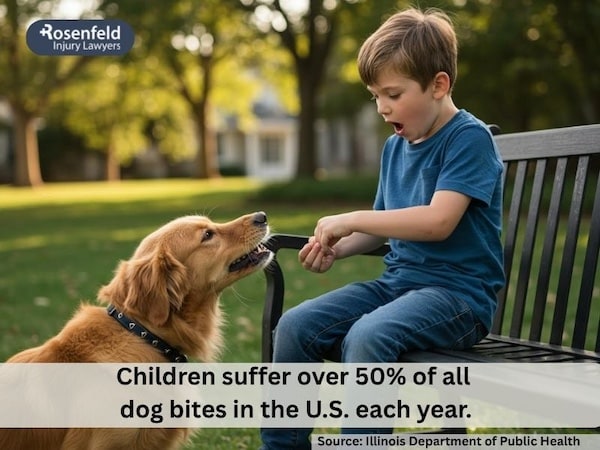
How many children are bitten by dogs each year? About 4.5 million Americans are bitten annually, and at least half are children, according to AVMA estimates based on 2001–2003 survey data. That means more than 2 million children may be bitten each year. Children ages 5 to 9 have the highest emergency-room dog-bite rate.
The true number may be higher, as most bites are not treated in emergency departments and therefore do not become part of statistics. At Rosenfeld Injury Lawyers, our Chicago dog bite lawyers represent Illinois families whose children were hurt in dog attacks, so we follow this data closely.
Key Stats at a Glance: Children Dog Bite Statistics
- About 4.5 million people in the U.S. are bitten by dogs each year (AVMA estimate from 2001–2003 survey data).
- At least half of those bitten are children (AVMA, same 2001–2003 survey data).
- Nearly 1 in 5 people bitten need medical care (CDC Healthy Pets).
- Children are more likely than adults to be bitten and to be badly hurt (CDC Healthy Pets).
- Kids ages 5 to 9 have the highest ER bite rate: 202.9 per 100,000 (NEISS data, 2005–2018).
- 8.0% of children treated for dog bites at U.S. children’s hospitals needed surgery (2015–2020 data).
- 81 people died from dog bites or strikes in 2021, the highest yearly total from 2011 to 2021 (CDC, 2023).
So, How Many Children Are Bitten by Dogs Each Year in the U.S.?
More than 2 million children are bitten by dogs each year, based on the AVMA estimate that half of 4.5 million bite victims are children. A much smaller share ends up in the emergency room.
The University of Rochester Medical Center also puts the figure at over 2 million children a year. Hospital data tells a narrower story. A study in Public Health Reports (2020) estimated that ER visits for dog bites among people ages 0 to 19 fell from about 181,090 in 2001 to about 118,800 in 2017.
Why Child Dog Bite Numbers Vary
Child dog bite figures differ because they come from three kinds of data. Household surveys count every bite, even minor nips treated at home. ER data counts only bites serious enough for an emergency visit. Children’s hospital data counts only kids treated at those hospitals. Many bites are never reported at all. That is why you will see estimates as high as 2 million children and as low as a few hundred thousand.
Dog Bite Rates by Age
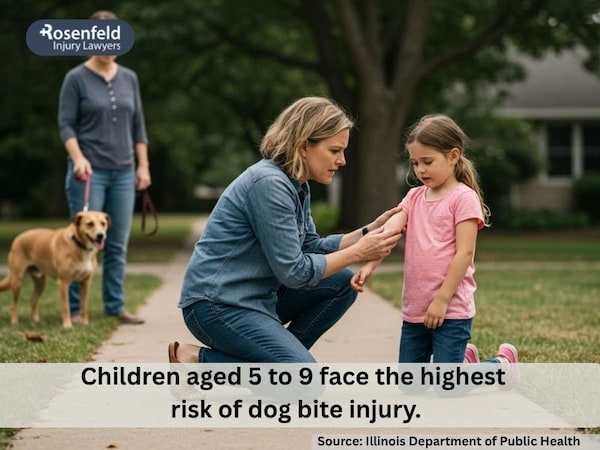
Wondering how many children are bitten by dogs each year and which age group is most affected? Children ages 5 to 9 are bitten more often than any other age group. Emergency-room data from 2005 to 2018 shows this group had 202.9 dog bite visits per 100,000 people, followed closely by kids under 5.
| Age group | ER dog bite visits per 100,000 (2005–2018) |
| 0–4 | 183.9 |
| 5–9 | 202.9 |
| 10–14 | 155.4 |
| 15–19 | 111.4 |
| 20–44 (adults, for comparison) | 108.9 |
Source: National Electronic Injury Surveillance System (NEISS) data analyzed by Tuckel and Milczarski, Injury Epidemiology, 2020.
Boys are bitten more than girls through age 14. Among kids ages 5 to 9, the rate was 228.4 for boys and 176.4 for girls. Among ages 10 to 14, it was 184.4 for boys and 125.1 for girls. Child bite rates rose until about 2012, then fell steeply.
What Children’s Hospital Data Shows
Children’s hospital records show most kids are bitten in early grade school, usually on the head. A nationwide study in the Journal of Craniofacial Surgery (2022) reviewed 56,106 children treated for dog bites at U.S. children’s hospitals from 2015 to 2020.
- The median age was 6.8, and 55.1% of patients were boys.
- The head was bitten in 62.1% of cases, and the arm or hand in 25.1%.
- 8.0% of children needed surgery in an operating room.
- Cases peaked in July and dipped in February. Summer break means more time outside and more time around dogs.
- Dog bites made up 0.33% of ER visits at these hospitals before the pandemic, then nearly tripled to 0.80% during it.
Where Do Most Dog Attacks on Children Occur?
Most children are bitten by a dog they already know. A 2006 study published in Pediatrics found about 82% of biting dogs were known to the child rather than unfamiliar dogs. These can include family dogs, a neighbor’s dog, or a relative’s dog. The Los Angeles County Department of Public Health reports that around half of all dog attacks occur in the family home or in a public place with familiar dogs, such as when seeing a neighbor’s pet on a walk. In our experience handling Chicago dog bite cases, many child bites involve a dog the family knew and trusted.
This may be because knowing the animal creates a false sense of security. Some dog breeds, such as Labrador Retrievers, have become renowned as family dogs, while others may perpetuate the myth that pit bulls are “nanny dogs.” Failing to properly supervise young children around any dog, regardless of its particular breed, can result in serious injury or death.
The Severity of Dog Bite Injuries in Young Victims
Younger children have a higher risk of severe injuries or fatalities than adults for several reasons, many of which may be avoided through dog bite prevention training.
A High Percentage of Bites are to the Head and Neck
Children are more likely to suffer dog bite wounds to the head and neck, which can result in disfigurement or death. In the 2015–2020 children’s hospital data, 82.5% of children under age 3 had facial injuries (Plastic and Reconstructive Surgery Global Open, 2022).
These severe bites occur for several reasons. Children are shorter, so their faces are typically at eye level for the dog. They also have a proportionally larger head, making the head an easier target. Lastly, children are weaker and cannot defend themselves. We explain these factors in more depth in our post on why children are at greater risk for dog bites.
The Need for Reconstructive Surgery
Because children often receive the most severe injuries on the face, they may also present in the operating room for reconstructive surgery. In 2018, the American Society of Plastic Surgeons reported nearly 27,000 reconstructive procedures for dog bite injuries.
A five-year review of 2013–2018 hospital data (Western Journal of Emergency Medicine, 2021) found that 17% of pediatric dog bite injuries required a surgical specialist.
If your child needed stitches, surgery or counseling after a dog bite in Illinois, the dog’s owner or their insurer may be responsible for those costs. Call our Chicago office at (312) 779-6171 for a free consultation. No fees unless we win.
The Tragic Reality of Fatal Dog Attacks on Children
Fatal dog attacks are rare, but they are devastating. Therefore, it is vital to know as how many children are bitten by dogs each year. The CDC counted 468 deaths from being bitten or struck by a dog from 2011 to 2021, an average of 43 a year. Deaths reached 81 in 2021, the highest total in that period, and more than doubled between 2018 and 2021 (CDC MMWR, September 2023). The CDC report does not break deaths down by age, so it cannot tell us how many victims were children. When a child dies, Illinois law may allow a wrongful death claim for a fatal dog attack.
The Role of Dog Breed in Injury Severity
The CDC stopped collecting breed data for fatal dog attacks in 1998, and the AVMA and ASPCA do not support breed-specific laws. Breed labels in bite reports are often unreliable because victims may guess, and one shelter study found a third of dogs labeled pit bulls had no pit bull DNA. For a child, a dog’s size, history and supervision matter more than its label.
The American Veterinary Medical Association on Dog Bite Prevention
The American Veterinary Medical Association (AVMA) emphasizes that any dog, regardless of its size or breed, may bite. Never leave a baby or young child alone with any dog, including the family pet, and teach kids to leave sleeping or eating dogs alone. Our guide on how to prevent dog bites in children covers the full safety checklist for Illinois parents.
Your Family’s Legal Rights After a Child is Bitten by a Dog
Under the Illinois Animal Control Act, 510 ILCS 5/16, an owner, including anyone who keeps, harbors or cares for the dog, is generally liable when the dog attacks or injures someone acting peaceably where they have a legal right to be, without provoking the dog. In most cases, the injured person must show there was no provocation (Kirkham v. Will). A claim for a child can generally be filed until two years after the child turns 18 (735 ILCS 5/13-211). You can learn more about what happens when a dog bites a child in Illinois.

What Compensation Can Be Recovered for a Child’s Injuries?
Families may be able to recover costs such as ER and follow-up care, reconstructive surgery, counseling for trauma, pain and suffering, scarring, and loss of normal life. Every case is different, and no lawyer can promise an amount.
How Our Firm Handles Child Dog Bite Cases
Our attorneys hold a Super Lawyers rating and have more than 25 years of experience. We use age-appropriate interview methods, protect a child’s privacy, and often discuss structured settlements that pay for future medical care and counseling.
Our Settlements for Dog Bite-Related Attacks
Past results do not guarantee a similar outcome. As one example listed on our Illinois dog bite settlements page, the firm recovered $1,200,000 for a toddler attacked by a Doberman Pinscher at a relative’s home who needed multiple plastic surgeries.
FAQs
Children ages 5 to 9. They had the highest ER dog bite rate from 2005 to 2018, with toddlers and preschoolers close behind. Where kids are bitten also shifts with age. Children’s hospital data from 2015 to 2020 shows the share of face bites drops by about 3.4% for each year of age, while arm and leg bites become more common as kids grow taller.
About half. The AVMA estimates at least 50% of the 4.5 million people bitten each year are children, based on 2001–2003 survey data. Children also make up an outsized share of serious bites, because the CDC notes they are more likely than adults to need medical care and to be badly injured. Exact percentages vary depending on whether the data comes from surveys or hospitals.
Usually, yes, or by another dog they know. Research has found that roughly 8 in 10 dogs that bite children are familiar to the child, including family pets and dogs owned by neighbors or relatives. Familiarity is part of the problem. Parents often relax supervision around a gentle pet, and young children may hug, grab or climb on a dog they trust.
There is no single official yearly count for children. The CDC counted 468 dog-related deaths of all ages from 2011 to 2021, including 81 in 2021, but that report does not break deaths down by age. Child deaths are rare compared with the millions of bites each year, yet each one is devastating, and most involve a dog the family knew.
The head and face. In children’s hospital data from 2015 to 2020, 62.1% of bites were to the head and 25.1% to the arm or hand. Age changes the pattern. Most toddlers under 3 were bitten on the face, while teens 13 and older were more often bitten on the arms, which accounted for 40.9% of their injuries.
Contact Our Child Injury Attorneys Today
If your child was hurt by a dog in Chicago or anywhere in Illinois, you do not have to sort out the medical bills and insurance calls alone. Call Rosenfeld Injury Lawyers at (312) 779-6171 or contact our Chicago office for a free consultation. There are no fees unless we win. We will explain your family’s options in plain language and handle the calls with the owner’s insurer while your child heals.
This article is for general information and is not legal advice.
 Legally Reviewed By
Attorney Jonathan Rosenfeld
Content legally reviewed by Jonathan Rosenfeld The information on this page has been legally reviewed by Attorney Jonathan Rosenfeld, founder and managing partner of Rosenfeld Injury Lawyers LLC. With extensive experience representing dog bite victims across Chicago, Mr. Rosenfeld is dedicated to helping injury victims hold negligent dog owners accountable and pursue the maximum compensation available under the law. His deep legal knowledge and commitment to client advocacy ensure that the information provided is accurate, reliable, and aligned with current legal standards.