- Free Case Evaluation: 312-779-6171 Tap Here To Call Us




What Is Considered a Dangerous Dog in Illinois?


Understanding what is considered a dangerous dog in Illinois is important if you’ve suffered a dog attack on public or private property. Under the Illinois Animal Control Act, a dog can be declared dangerous or even deemed vicious depending on its behavior, prior incidents involving other animals or people, and clear and convincing evidence gathered through an animal control investigation.
Our Chicago dog bite law firm is committed to standing with victims during this difficult process, offering support, guidance, and strong legal representation. We believe in your case and are here to help protect your rights while holding a dangerous or vicious dog’s owner accountable under Illinois law.

How Does Illinois Law Define Dangerous Dogs?
Under Illinois law, the term dangerous dog is defined in 510 ILCS 5/2.05a of the Illinois Animal Control Act. According to that statute:
“Dangerous dog” means (i) any individual dog anywhere other than upon the property of the owner or custodian of the dog and unmuzzled, unleashed, or unattended by its owner or custodian that behaves in a manner that a reasonable person would believe poses a serious and unjustified imminent threat of serious physical injury or death to a person or a companion animal or (ii) a dog that, without justification, bites a person and does not cause serious physical injury.
What Is a Vicious Dog?
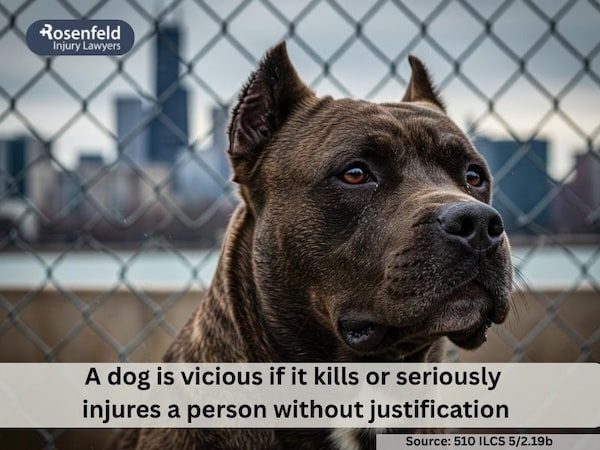
Illinois defines a vicious dog in 510 ILCS 5/2.19b. The statute states:
“Vicious dog” means a dog that, without justification, attacks a person and causes serious physical injury or death or any individual dog that has been found to be a “dangerous dog” upon 3 separate occasions.
It’s important to note that Illinois law makes it clear that breed alone does not determine whether a dog is considered dangerous or vicious, the classification depends on the behavior and circumstances of the attack.
What Are Potentially Dangerous Dogs?
While “potentially dangerous dog” is not always a formal state-level classification, some local agencies and municipalities in Illinois (and in Chicago dog laws particularly) adopt this term as a warning or intermediate step prior to a full dangerous or vicious dog designation.
510 ILCS 5/2.17c includes a narrow statutory definition:
“Potentially dangerous dog” means a dog that is unsupervised and found running at large with 3 or more other dogs.
However, this statutory definition is limited and seldom covers all the behaviors that local animal control services may associate with this label. In practice, agencies may designate a dog “potentially dangerous” if it:
- Exhibits aggressive or threatening behavior toward people or other animals but has not yet bitten or injured them,
- Chases, lunges, or otherwise physically threatens individuals (sometimes unprovoked),
- Shows escalating warnings, such as growling, snapping, or charging, without actually making contact.
When a local agency labels a dog “potentially dangerous,” the owner may be required to take preventive steps, such as:
- Enrolling the dog in behavioral training or evaluation by a certified expert,
- Using a leash or muzzle when the dog is in public,
- Installing a secure fence or enclosure on the property,
- Monitoring or limiting unsupervised access to public areas.
How Is a Dog Deemed Dangerous in Illinois?
A dog is deemed dangerous in Illinois only after a thorough investigation. Authorities review witness statements, medical records showing the severity of the injuries, and any past incidents involving the same dog. They also consider whether the dog was provoked or if the attack occurred while the person was lawfully on public or private property.
If the evidence shows the dog’s behavior meets the legal definition, the agency issues a dangerous dog classification. The dog’s owner has the right to challenge this decision through an appeal process in circuit court, where evidence is weighed to decide whether the classification should stand.
What Are Dog Owners’ Obligations After a Dangerous Dog Designation?
Once a dog is designated dangerous in Illinois, the owner must follow strict requirements to protect the public. The law may require that the dog be spayed or neutered, microchipped, and kept in a secure enclosure on the owner’s property. When taken off the property, the dog must be leashed and, in many cases, muzzled to prevent further attacks.
Owners may also be ordered to carry liability insurance, register the dog with the local animal control services, and pay fines or fees. If the owner fails to comply with these obligations, the dog’s life may be at risk. Animal control has authority to impound or even euthanize a dangerous or vicious dog when violations occur.
These rules exist to ensure the safety of human beings, pet animals, and other domestic animals who might otherwise be placed at risk by repeated incidents of aggressive behavior.
How a Dangerous Dog Determination Impacts Dog Bite Victims’ Legal Rights
For dog bite victims, a dangerous dog classification can significantly strengthen a civil case. When an animal care and control agency declares a dog dangerous, it establishes foreseeability of harm which can act as proof that the owner knew or should have known the dog’s behavior posed a risk.
This determination also supports claims for negligence and, in some cases, punitive damages, since it shows a pattern of aggression or repeated incidents involving the dog.
Illinois law takes these findings seriously. If a dog is repeatedly found off-leash or threatening despite warnings, the Justice for Buddy Act may apply. This statute allows the state to declare the owner reckless and, in severe cases, requires forfeiture of the dog.
For victims, this demonstrates that the law recognizes the danger and provides additional evidence to hold the owner accountable for injuries and long-term medical needs.
What Damages Can Dog Bite Injury Victims Recover in a Personal Injury Lawsuit?
Victims of dog attack injuries in Illinois have the right to pursue compensation for the harm they’ve suffered. A personal injury lawsuit can address both the immediate and long-term impact of the attack.
Recoverable damages may include:
- Medical expenses – Emergency care, surgery, hospitalization, and the cost to obtain veterinary care for an injured companion animal.
- Future treatment – Ongoing care such as physical therapy, plastic surgery for scarring, or counseling for emotional trauma.
- Lost wages and reduced earning capacity – Compensation if the injury prevents a person from working or permanently limits their ability to earn a living.
- Pain and suffering – Recognition of the physical and emotional distress caused by the attack, including PTSD, fear of dogs, and lasting anxiety.
- Disfigurement and disability – Damages when a bite results in permanent scarring or loss of function.
- Wrongful death damages – In tragic cases where a dog causes a lethal outcome, surviving family members may pursue compensation for funeral costs, loss of support, and emotional suffering.
The extent of compensation depends on the severity of the physical injury, the circumstances of the attack, and whether the dog had prior incidents exhibiting aggression or was already deemed dangerous or vicious under Illinois law.
How an Experienced Attorney Can Help
At Dog Bite Injury Lawyer, we provide dedicated support for victims of dog attacks in Illinois.
Our services include:
- Conducting a thorough investigation of the dog’s behavior, past incidents, and the animal control agency’s determination.
- Collecting witness statements, medical records, and other clear and convincing evidence to prove your case.
- Working with experts to document physical injury, emotional trauma, and long-term needs.
- Negotiating with insurance companies to seek fair compensation.
- Representing clients in circuit court when an appeal process or hearing is required.
- Ensuring owners comply with state law obligations after a dangerous dog classification.
Secure Expert Legal Representation
If you or a loved one suffered an injury caused by a dangerous or vicious dog, you don’t have to face this alone. Our firm offers a confidential, free consultation, and we work on a contingency fee basis, meaning you pay nothing unless we recover compensation for you.
Contact us today to protect your legal rights and secure the representation you deserve.
Content reviewed by Chicago dog bite lawyer Jonathan Rosenfeld of Rosenfeld Injury Lawyers LLC, who hold dog owners accountable to secure compensation for injured victims and their families, and is a trial lawyer recognized by Super Lawyers, the American Association of Justice, and Million Dollar Advocates for serious crash cases across Illinois.