- Free Case Evaluation: 312-779-6171 Tap Here To Call Us




Can a Dog Bite Break a Bone?


“Can a dog bite break a bone?” is an unequivocal yes. Many dog bite victims suffer broken bones, especially children or those who have more fragile bones.
A dog’s powerful jaws, combined with the aggression of the attack and the victim’s attempts to escape, can lead to deep wounds and compound fractures. These fractures often require surgery and physical therapy to heal.
If you have open wounds or broken bones caused by dog bites, seek medical attention immediately, then contact us for a free legal consultation.
How Dog Bites Lead to Severe Bone Fractures
Dog bite bone fractures occur due to two situations, depending on how the bite occurred and the victim’s actions after the attack.
Direct Trauma from the Bite Itself
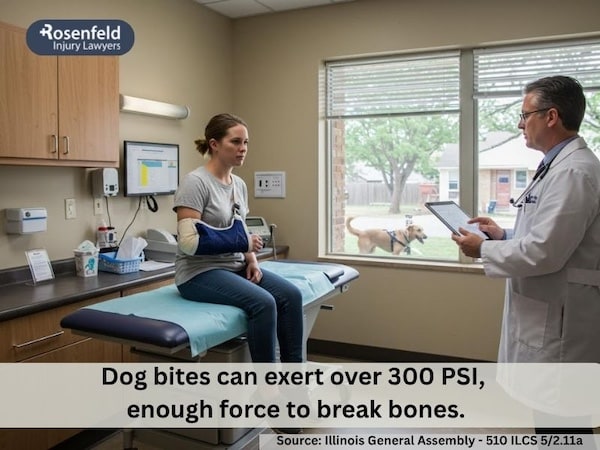
The average bite force of a large dog is around 320 pounds per square inch (psi), which is roughly 1,420 newtons per square inch (N/in²). The human femur, the strongest bone in the body, fractures at around 4,000 newtons of force. In other words, if a dog’s bite of 320 PSI were applied over just three square inches of surface area, it would generate about 4,270 newtons. This is enough to crush a femur.
The above example uses an adult human femur; however, around 50% of all dog bites occur to children, who have smaller bones and a reduced ability to defend themselves.
Many dog bite injuries are to the face and hands, which have smaller and more delicate bones. Reports estimate that around 5% of dog bites involve facial bone fractures, including skull fractures. In adults, fractures occur most often in the hands as the person attempts to push the animal away or defend themselves.
Given how small these bones are, the average dog’s bite is more than enough to crush bones.
Indirect Trauma from Falls During an Attack
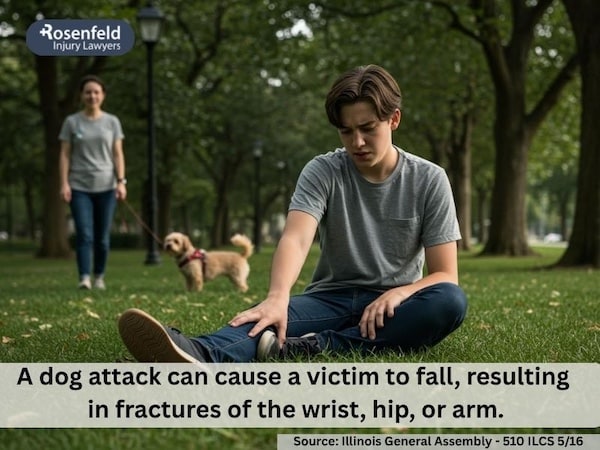
Another common cause of serious injuries in dog bite incidents is when the animal lunges or jumps on the person, such as during rough play with a large, excitable dog. Even if the dog did not mean to attack, a sudden fall onto a hard surface can break a hip, wrist, or arm bone.
In severe cases, such as if multiple dogs are attacking the victim, they may attempt to flee and fall, resulting in both broken bones and other injuries.
Common Types of Fractures Seen in Dog Bite Cases
Multiple types of serious fractures occur in dog attacks, which often require physical therapy and long recovery times. Some of the most common traumatic injuries that professionals see include the following.
- Comminuted Fractures: These crush injuries occur when the bone breaks into multiple pieces. Recovery times for these serious injuries can take up to a year or more, which takes a significant financial toll on the victim.
- Avulsion Fractures: An avulsion fracture occurs when soft tissue, like a ligament or tendon, pulls away a chip of bone. Not only is this painful, but it can also result in nerve damage.
- Open (Compound) Fractures: One of the most severe injuries that can result from a dog bite is a compound fracture, where the bone breaks through the skin. The victim will need immediate medical care to stop bleeding, prevent infection, and repair the bone.
Where Do These Dog Bite Injuries Typically Occur?
Common broken bones from by a dog bite include:
- Fingers
- Wrists
- Legs
- Hips
- Collar bones
- Facial bones
- Skulls
The Medical Treatment and Recovery Process for Injuries Caused by Dog Bites
Broken bones from an animal bite cause severe pain and high medical expenses. Some victims take months to recover, often necessitating surgery and physical therapy.
Immediate and Emergency Care
A dog bite victim must immediately go to the emergency room for proper treatment. This process can include taking X-rays to diagnose the type of fracture, setting the bone, and applying a cast or splint. Victims may also receive antibiotics and vaccines.
Surgical Intervention and Long-Term Rehabilitation
For more severe fractures, the victim may need surgery to stabilize the bone. This can include installing plates, screws, or rods to hold the bone together and ensure that it realigns. Additionally, the victim may need rehabilitation to regain their mobility and strength.
Your Legal Rights When Bitten by a Dog in Illinois
The Illinois Animal Control Act makes dog owners strictly liable for any injuries caused by their animal (510 ILCS 5/). Victims are entitled to financial recovery for both economic and non-economic losses associated with the dog bite.
How Strict Liability Helps Victims with Broken Bones
Strict liability means that the dog owner is fully liable for any injury caused by the dog. The victim does not need to prove that the owner was negligent. Rather, all the victim needs to prove is that the attack was unprovoked.
The Animal Control Act only releases owners from strict liability in very specific cases, such as if the animal was in pain, guarding their owner, acting in self-defense, or guarding puppies (510 ILCS 5/). However, the owner has to prove this, not the victim.
This was further affirmed in the appellate case of Scollard v. Williams. In this case, the victim was bitten by a Husky they had been attempting to rescue. The court determined that the defendant could not use the assumption of risk as a defense for an animal attack and that merely being near an animal is insufficient to establish a defense for provocation.
Seeking Full Compensation for Broken Bones Caused by Dog Attacks
Our dog bite lawyers will negotiate with the liable parties for fair compensation, which includes both economic and non-economic damages. Through our expertise, we can accurately evaluate your damages and ensure that you receive everything to which you are entitled under the law.
Economic Damages
You can recover damages for all medical care associated with your injury. This can include emergency room visits, surgery, orthopedic consultations, reconstructive surgery, and rehabilitation costs. Medical costs can also include the cost of psychiatric medication or therapy to overcome Post-Traumatic Stress Disorder.
Lost wages are another significant factor in your damages. Your doctor will determine how much time you need to take off work or what duties you can perform during your recovery process. If you have to accept a lower-paying job because of your injuries, you can also receive lost income damages.
Non-Economic Damages
Dog bite incidents can cause significant pain as well as severe emotional distress. Your financial compensation can also include these elements.
Our team can calculate your pain and suffering damages in multiple ways. One of these is the injury multiplier, which assesses how severe your injuries are and how much they will impact your life. Your economic damages are multiplied by a denominator based on the overall severity.
For example, if you broke multiple bones in your leg and were unable to walk for a year, this may be assigned a 2. All your hard expenses, such as emergency room visits and time off work, would then be multiplied by 2.
Another option is to use the per diem method. In consultation with medical professionals, we assess the duration of your injury and then multiply the number of days by a set amount per day.
To ensure that we can negotiate for fair compensation, keep track of your symptoms, the limitations imposed by the broken bone, and your pain levels each day.
What if I Was Knocked Down But Not Actually Bitten?
The Illinois Animal Control Act makes owners liable for any injuries, not just bite wounds. The law defines physical injuries as “the impairment of physical condition,” which includes broken bones or soft tissue injuries (510 ILCS 5/2.18a).
As such, you can sue for broken bones even if you were not bitten by a dog, such as falling over while running away or being knocked over.
Contact Our Illinois Dog Attack Lawyers for a Free Consultation
Broken bones from a dog attack can be devastating, resulting in high medical bills and long recovery times. The best dog bite law firm in Chicago is here to help you get justice. Our award-winning attorneys work on a contingency fee basis: no fees unless you win. Contact us today for a free, no-obligation consultation.
Content reviewed by Chicago dog bite lawyer Jonathan Rosenfeld of Rosenfeld Injury Lawyers LLC, who hold dog owners accountable to secure compensation for injured victims and their families, and is a trial lawyer recognized by Super Lawyers, the American Association of Justice, and Million Dollar Advocates for serious crash cases across Illinois.