- Free Case Evaluation: 312-779-6171 Tap Here To Call Us




What Dog Breed Bites the Most?


The Alarming Reality of Dog Bite Statistics
Millions of people are bitten by dogs annually, with hundreds of thousands requiring medical attention. Dog bite statistics outline what dog breed bites the most, giving Illinois residents insights into preventing fatal human attacks.
Key Dog Bite Statistics Every Illinois Resident Should Know
- An estimated 4.5 million people are bitten by dogs yearly in the United States.
- There are approximately 334,000 emergency room visits for dog bites every year.
- An additional 466,000 dog bites require medical attention, such as at an urgent care or primary care physician.
- According to the Centers for Disease Control (CDC), there were 468 fatalities caused by dogs between 2011 and 2021.
- 50% of children will be bitten by a dog at least once during their childhood.
- 80% of pediatric dog bites occur in the family home.
Illinois Dog Bite Claims Statistics in a National Context
The Illinois State Bar Association notes that in 2015, Illinois was second only to California in terms of dog bite insurance claims. This is partly due to the strict liability imposed on dog owners for bites, which allows a dog to be labeled as dangerous after only one bite.
Ten years later, Illinois remains in the top ten for insurance claims related to dog bites. This is despite the fact that Illinois ranks 11th in the country for most responsible dog owners and is not in the top ten for the number of dogs per capita.
Which Dog Breeds Are Most Commonly Cited in Dog Attacks?
As the American Veterinary Medical Association notes, it is impossible to know the true number of dog bites, as only severe dog bites or those resulting in a human death are typically reported. Additionally, dog bites are typically self-reported by the victim, who may not know the animal’s breed.
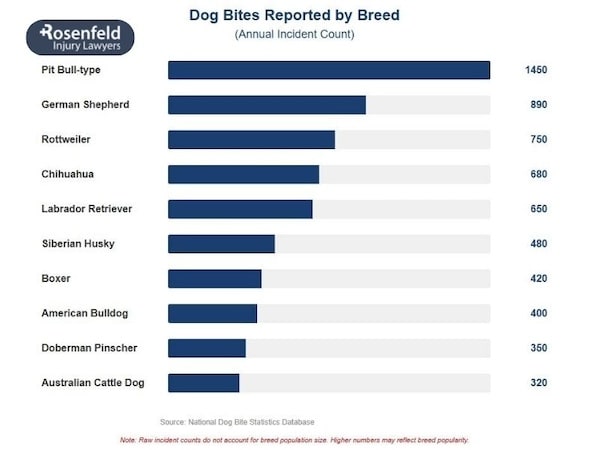
Regardless, statistics have implicated certain breeds as the most likely to cause severe injuries or even human fatalities.
Pit Bull-Type Dogs and Their Role in Dog Bite Statistics
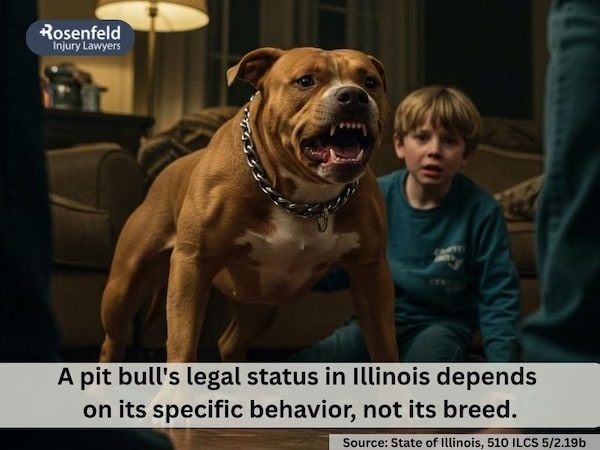
“Pit bull” is not one breed but an umbrella term for American Pit Bull Terriers, American Bullies, and mixed breeds called “pit bull type.”
A ten-year study found that pit bull breeds were responsible for 41.6% of fatal dog attacks. Another study, performed by the Ohio State University College of Medicine, found that pit bulls were significantly overrepresented in severe dog bites and fatalities. Forbes reports that in fatal dog attacks between 1979 to 1998, pit bulls accounted for 28% of all deaths.
However, the statistics on pit bull bites are challenging to decipher and may overrepresent their prevalence. In one study, approximately 60% of dogs identified as pit bulls were found not to have any pit bull DNA, suggesting that bite statistics may not accurately reflect whether this breed is the most dangerous.
Rottweilers: A Powerful Breed Also High in Statistics
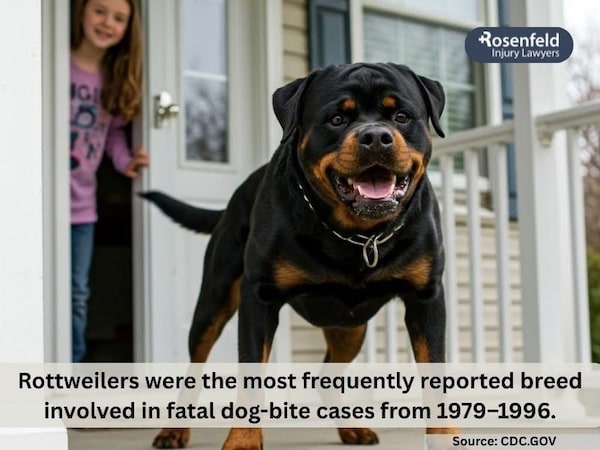
Rottweilers are an ancient breed known for their protective instincts and deep affection toward their families. However, they are also very large dogs, with some reaching up to 27 inches tall and 135 pounds.
They are comparable in weight to some adults, with a bite force to match. As a one-year-old child weighs only 20 pounds and is only a few inches taller than a Rottweiler, these animals can do significant damage.
In a study period between 1979 and 1998, these dogs were responsible for 39 deaths. As the CDC stopped tracking fatalities by breed in 1998, it is challenging to determine the current percentages.
German Shepherds: Protective Instincts and Aggressive Behavior
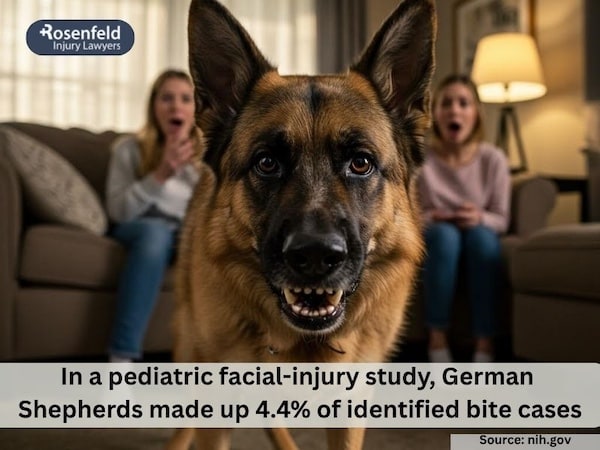
German Shepherds have been used as police dogs and guard dogs for decades due to their high prey drive, exceptional intelligence, and stamina. However, these same positive traits can lead to dog bite fatalities if the dog isn’t receiving adequate mental stimulation and training.
According to recent reports, German Shepherds are implicated in about 17.1% of all dog bites. They are third in the number of dog bite fatalities, with 17 deaths in the given study period.
It is important to acknowledge that training methods, rather than inherent aggression, may result in more dog bites yearly. Legal scholars note that attack training can cause many dogs to bite unprompted, as can confrontational training methods that encourage aggression.
As German Shepherds are the most popular police dog, this may make the breed seem more dangerous than it would be without aggression-based training.
Other Breeds Frequently Noted in Dog Bite Claims
The American Veterinary Medical Association released a report discussing the dog breeds commonly implicated in serious bites. In addition to the three mentioned above, these breeds were also included:
- Jack Russell Terrier
- Chow Chow
- Cocker Spaniel
- Saint Bernard
- Labrador Retriever
- Siberian Huskies
- Collie
- Doberman
- Lhasa Apso
- Springer Spaniel
- Shih Tsu
- Poodle
Is It the Dog Breed or the Owner’s Responsibility?
While statistics indicate that certain breeds are more likely to bite, experts agree that an individual dog’s behavior is a better indicator of whether it will bite or not. These organizations, like the National Animal Care & Control Association, also oppose breed-specific bans, as they fail to enhance public safety.
Dog owners can prevent bites through proper care, socialization, and medical treatment. Illinois law reflects this by placing strict liability on the owner, regardless of breed (510 ILCS 5/24).
Why Any Dog Has the Potential for Aggressive Behavior
The American Veterinary Medical Association notes that any dog, no matter its breed, can bite. Rather than assuming certain breeds are naturally aggressive dogs, the AVMA and other organizations encourage individuals and policymakers to consider the dog’s behavior and overall circumstances, as this can play a significant role in dog bite prevention.
Certain factors lead to serious dog bites or fatal dog attacks, whether from the above breeds or other dog breeds.
- Sterilization: Unneutered dogs of any breed are more likely to bite than fixed animals; in fact, intact males constitute 70% to 76% of all dog bites annually.
- Poor Dog Socialization: Proper socialization plays a key role in preventing dog bites, particularly those from high-risk, aggressive breeds. All dogs should be exposed to a wide variety of people, including children, to help them get comfortable with a range of human behavior.
- Lack of Proper Training: Resource guarding is a common problem in dogs of all breeds. Proper training teaches dogs not to resource guard, which helps prevent bites.
- Territorial Instincts: Dogs may feel threatened if a stranger makes direct eye contact with them or enters their territory without warning, which can result in a bite. While a dog’s personal space should always be respected, they should be taught to accept people in their home.
- Fear and Pain: Dogs or other animals that are afraid or uncomfortable may attack. Ensuring a dog has adequate medical attention is essential for avoiding bites.
The Problem with Labeling a “Dangerous Dog Breed”
A 2022 study utilized genetic testing and temperament testing to investigate whether the breeds most commonly targeted by breed legislation exhibited significant breed-wide differences in temperament or aggressive behavior. They found there was no appreciable difference between those breeds deemed “dangerous” and those not on the list.
While pit bulls, Rottweilers, and German Shepherds are considered dangerous, this may lull some dog owners into a false sense of security and discourage them from providing proper training for other dogs, particularly those that have been labeled as good family pets.
For example, Labrador Retrievers are large dogs that require significant mental stimulation to thrive. If they are not properly socialized or exercised, they may exhibit aggression.
While smaller breeds are unlikely to cause fatal bites in adults, owners may inadvertently encourage aggressive behavior in small dogs, such as by picking up the dog when it begins barking at larger dogs. There have been several cases of fatal dog attacks involving infants and small dogs. In one case, a terrier-Daschund cross mauled a four-month-old baby after dragging her out of her cot.
It is crucial to remember that any dog can cause serious injuries, especially for newborns and infants. Pet owners must remain vigilant and ensure their dogs are properly socialized before interacting with young children.
How Illinois Law Assigns Liability for Dog Bites
Illinois does not focus on breed when assigning liability for a dog attack. The Illinois Animal Control Act states, “Vicious dogs shall not be classified in a manner that is specific as to breed” (510 ILCS 5/15(3)).
To be considered a “vicious dog,” the animal must have bitten someone unprovoked, or it must have behaved in a manner that a reasonable person would consider threatening. The animal must have been unleashed, unmuzzled, or unattended by a custodian (510 ILCS 5/2.05a).
In other words, a dog snapping or growling at someone who gets too close while it is on a walk would not be considered vicious if it did not bite someone.
Additionally, the act states that municipalities cannot impose ordinances that specifically target a breed (510 ILCS 5/24). Insurance companies are prohibited from denying or revoking insurance coverage due to a dog’s breed; however, they can revoke coverage if the dog is classed as vicious (Public Act 103-0011).
Illinois’s “Strict Liability” Law: The Owner Is Responsible
As mentioned before, part of the reason that Illinois continues to lead the nation in insurance claims for dog bites is that it imposes strict liability on owners for their animal’s behavior. Some states have what lawyers call the “one free bite” rule, meaning that a dog cannot be deemed as vicious until it has a bite history.
Illinois has determined that any dog that bites anyone unprovoked, regardless of its bite history, can be deemed dangerous. If a dog bites someone, the owner is always liable for the damages, such as medical bills, lost income, and emotional trauma.
An animal may not be deemed dangerous in certain rare circumstances, such as if it was in pain, protecting puppies, or was provoked by the victim. Dogs also cannot be blamed if they were protecting themselves, their owners, or their property (510 ILCS 5/15).
However, the burden of proof in these instances is upon the owner, not the victim. They must prove that the victim was engaged in a crime against the dog or its owner at the time of the attack, such as throwing rocks at a chained-up dog or threatening the owner. Otherwise, they are strictly liable.
In these cases of contested liability, courts can turn to the “reasonable dog” standard introduced in the court case Kirkham v. Will. This standard encourages juries to consider what a well-trained, socialized, and healthy animal would do in certain circumstances rather than anthropomorphizing a dog.
For example, a reasonable dog would not assume any visitor is a threat unless it is a professionally trained guard dog that had been trained not to allow any unknown visitor to a home. However, a reasonable dog may bite if the visitor assaults or hits its owner.
Because Illinois does not discriminate based on breed, an owner cannot use a dog’s breed as a legal defense. For instance, if a person was bitten by a Standard Poodle, the focus of a court case would be on the individual dog’s health and behavior before the attack. The defense could not submit evidence of Standard Poodle temperaments on a breed-wide basis as justification.
What Makes Us The Best Lawyers for Dog Bite Injury Cases in Illinois?
Our Super Lawyers-rated attorneys understand both the statistical realities and legal nuances of these complicated cases. We also acknowledge the significant mental and physical toll that a bite can take on a person and their family, particularly if the dog is a relative’s or neighbor’s pet.
We hold the owner accountable regardless of the dog’s breed, using strong evidence to demonstrate that the animal poses a threat to human safety and well-being. Through this process, we ensure that you receive fair compensation that addresses all your needs.
We will also defend you against common insurance company tactics like blaming the victim or claiming that your injuries aren’t covered by the specific policy.
While many cases settle before trial, we prepare every case for the courtroom, as this ensures that you have the best chance of maximum compensation. We are members of the Illinois Trial Lawyers Association, known for our impeccable success rate. Through our network of experts and deep knowledge of local laws, we can convincingly present your case to a judge and jury.

Our Settlements for Dog Bites in Illinois
As Million Dollar Advocates, we have developed a strong reputation for achieving high settlements, such as the following.
- $1,200,000: Annie was staying at her grandparents’ house in Downers Grove for the weekend. While playing in the backyard with the family pet, the Doberman Pinscher turned on her, causing facial scarring. Though the grandmother claimed that Annie provoked the animal, our animal behavior experts proved this was untrue.
- $885,000: Josh was enjoying a cookout at his family’s Crystal Lake cabin when a pit bull broke out of a neighboring backyard and charged him. He was pushed into the bonfire, resulting in severe burns, broken bones, and bites.
- $177,555: Al, a delivery driver, was dropping off a package in West Chicago when a Giant Schnauzer jumped a fence and attacked him. He suffered severe nerve damage to his dominant hand that required an extended leave of absence from work.
Investigating Dog Bite Incidents to Build a Strong Claim
As members of the American Association of Justice (AAJ), Dog Bite Injury Lawyer is renowned for our thorough investigations and strong advocacy. We will handle all third-party communication and negotiation on your behalf so that you can focus on recovery. Our services include the following tasks.
- Gathering Evidence: Understanding how the bite occurred can demonstrate that you were not provoking the animal, which is a common defense used in these cases. We will search for police reports, Animal Control records, and surveillance footage. Through this, we can reconstruct the attack and determine what factors were involved.
- Evaluating Damages: To win your case, we must verify your damages and estimate what future costs you may have. Using medical records, we will build a life care plan that explains what treatment you need, such as reconstructive surgery or therapy.
- Interviewing Witnesses: While many bites occur in the family home and may not have been witnessed, we will interview anyone who was present before and after the attack to gain their perspective on what occurred. This eliminates defenses that the bite was provoked or that the victim was intimidating the animal.
- Reviewing the Dog’s Records: As mentioned, Illinois does not have a “one free bite” rule, so the animal does not need to have a bite history in order to be deemed dangerous. However, owners may argue that their animal was provoked or in pain. By investigating the animal’s veterinary records, we can prove that the dog had a history of aggressive behavior and was in good health.
- Identifying Liability: An owner’s actions can demonstrate whether they are liable for the attack. For example, allowing an aggressive dog to roam off-leash or without a muzzle can demonstrate negligence. Failing to repair broken fences or tying up a dog within range of public property also shows negligence.
- Conferring With Experts: Veterinary experts and dog trainers can explain to a jury whether the animal’s behavior was reasonable based on the specific conditions. For example, they can explain why intact male dogs are more aggressive and why responsible ownership requires sterilization unless the animal is being used for breeding purposes.
Through this careful investigation, we provide you with a strong case and maximize your settlement.
FAQs
Does Illinois Ban Specific Dog Breeds?
No. Illinois has a ban on breed-specific legislation (510 ILCS 5/24) and does not allow insurance companies to refuse coverage based on a dog’s breed (Public Act 103-0011).
Can I File a Dog Bite Claim if I Was Bitten by a Breed Not Considered “Dangerous”?
Yes, you can file dog-related injury claims regardless of whether the dog was considered a dangerous breed or not.
What Is the Average Settlement for a Dog Bite in Illinois?
According to VerdictSearch, the average settlement for a dog bite is $162,917. How much you receive depends on injury severity, liability, available insurance, and available evidence.
Does the Dog Have to Be Put Down After It Bites Someone?
Not necessarily. The Illinois Animal Control Act handles dog bite cases on an individual basis. The biting dog will be taken to a facility and observed by a veterinarian, who will determine whether it felt threatened or had a medical condition that caused it to bite (510 ILCS 5/13).
How Long Do I Have to File a Claim for Dog Bite Fatalities?
You have two years after the person’s death to file a wrongful death claim for a fatal dog attack (740 ILCS 180/).
Book a Free Consultation
While dangerous dog breeds may have a reputation for violence, any dog can be dangerous if it is not well-trained and cared for. Our Chicago dog bite lawyers aggressively advocate for victims, ensuring that they receive fair compensation regardless of the animal’s breed.
Our law firm works on a contingency fee basis: no fees unless we win. Contact us today to schedule your free consultation.
Content reviewed by Chicago dog bite lawyer Jonathan Rosenfeld of Rosenfeld Injury Lawyers LLC, who hold dog owners accountable to secure compensation for injured victims and their families, and is a trial lawyer recognized by Super Lawyers, the American Association of Justice, and Million Dollar Advocates for serious crash cases across Illinois.