- Free Case Evaluation: 312-779-6171 Tap Here To Call Us




Illinois Dog Bite Law: Key Facts, Statistics & Your Rights


Illinois dog bite law generally makes a dog owner liable when a dog attacks, attempts to attack, or injures someone without provocation while that person is peaceably present where they may lawfully be. The Illinois Animal Control Act also establishes reporting, animal-control, and filing requirements.
At Chicago Dog Bite Injury Lawyers, we stand with dog bite victims across Illinois. We help injured people understand their rights under the Illinois Animal Control Act and the legal options available after a dog attack.

How Common Are Dog Bite Incidents?
Dog bite incidents are remarkably frequent. There are 4.5 million people bitten by dogs each year nationwide, and over 800,000 of those bites demand medical attention. About 316,000 victims end up in the emergency room each year due to injuries sustained in dog bites and attacks.
According to the Insurance Information Institute and State Farm, insurers recorded 28,450 dog bite and other dog-related injury claims nationwide in 2025, with total claim costs of approximately $1.86 billion. The average cost per claim was $65,450.
These figures include dog-related injuries beyond bites, such as fractures and other blunt-force trauma, so they should not be treated as a count of every dog bite reported to medical or animal-control agencies.
Illinois is deeply affected by these trends. In 2025, Illinois recorded 1,283 dog bite and other dog-related injury claims, with approximately $102 million in total claim value and an average cost of $79,596 per claim.
These dog bite facts show why understanding Illinois law and knowing how to document an injury matters after an attack.
How Many Dog Bite Claims Are Filed in Illinois Each Year?
Illinois continues to rank among the states with the highest number of dog-related insurance claims.
In 2025, insurers recorded 1,283 Illinois dog bite and other dog-related injury claims. The total value of those claims was approximately $102 million, with an average cost of $79,596 per claim. Illinois ranked eighth nationally by number of claims.
These figures are insurance claim data, not a count of every dog bite reported to police, animal control agencies, hospitals, or other authorities.
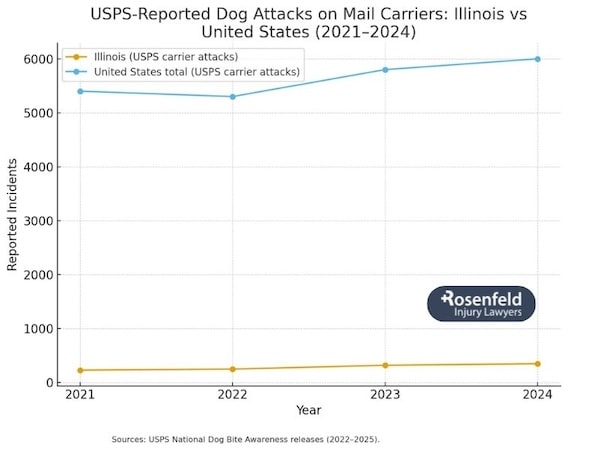
For postal workers specifically, USPS reported 260 dog attacks in Illinois in 2025. Chicago recorded 43 attacks and ranked fifth among U.S. cities in that year’s USPS data.
These multi-year figures show steady volume and high stakes. Every year, hundreds of personal injury lawsuits are filed in Illinois over dog bites, many involving medical expenses, reconstructive surgery, long recovery, and emotional distress.
What Are the Most Common Injuries Sustained in Dog Attacks?
Dog bite victims often sustain severe physical harm. Across the U.S.:
- Arm/hand injuries account for 47.3% of bites
- Leg/foot injuries 21.5%
- Head/neck injuries 26.8%
- Trunk 4.4%
The face is a common target, especially in child victims. Puncture wounds, lacerations, nerve and tendon damage, infections, broken bones, and scarring are the most frequent types of injuries.
In more than 27,000 cases per year in America, victims need reconstructive surgery due to dog bites. Even after care, many suffer lingering emotional distress, anxiety, and fear. This shows how serious an attack can be since even a single bite can lead to long-term consequences.
Who Are the Most Common Victims of Dog and Animal Attacks?
The demographics of dog bite victims are clear: Children, especially ages 5–9, bear the highest risk of serious injuries. Many bites in kids are to the head, face, and neck because of their height and defenseless posture.
In adults, the most common targets include postal workers, delivery drivers, visitors to private property, or random passersby. USPS reported 260 dog attacks involving postal employees in Illinois during 2025, while Chicago recorded 43 such incidents.
In Illinois counties like Cook County, DuPage County, Will County, and others, local animal control reports frequently document dog-related injuries involving family members, neighbors, and workers as well.
What Dog Breed Attacks Most Often?
Breed-based statistics should be interpreted cautiously. Breed identification can be unreliable, and breed alone does not establish whether an individual dog is dangerous or whether an owner is legally liable.
Over the period of 2005 to 2017, pit bulls alone were implicated in nearly 66% of fatal dog attacks in the U.S. Combining pit bulls and Rottweilers, the same source attributes as much as 76% of all fatal attacks to those two groups.
However, experts warn that breed identification is often unreliable. The American Veterinary Medical Association stresses that breed alone is not a reliable predictor of aggression. Under law, a dog’s breed does not determine liability, and what matters is the dog’s conduct.
For an Illinois dog bite claim, the incident circumstances, the victim’s conduct, the dog’s conduct, and applicable statutory requirements matter more than breed alone.
What Laws Govern Dog Bites in Illinois?
Dog bite liability in Illinois is governed by the Illinois Animal Control Act (510 ILCS 5/). Under this section, an owner can be liable when a dog or other animal, without provocation, attacks, attempts to attack, or injures a person who is peaceably conducting themselves in a place where they may lawfully be.
This means a victim generally does not need to establish that the owner was negligent in failing to control the dog. The statutory requirements still must be satisfied, including the absence of provocation and the victim’s lawful presence.
The Act also outlines procedures for dangerous dog investigations, rabies inoculations, and mandatory reporting of dog bites and other animal attacks to animal control. Local ordinances may impose additional requirements, so the facts of a particular incident should be reviewed under both state and applicable local rules.
What You Must Prove Under the Illinois Animal Control Act
Under 510 ILCS 5/16, an injured person generally must establish the statutory elements of the claim. These include:
- The defendant qualifies as the dog’s owner under the Act.
- The dog attacked, attempted to attack, or injured the person.
- The attack or injury occurred without provocation.
- The injured person was peaceably conducting themselves.
- The injured person was in a place where they were legally permitted to be.
The Illinois Animal Control Act defines “owner” broadly. Under 510 ILCS 5/2.16, an owner can include a person who has a property right in the animal, keeps or harbors it, has it in their care, acts as its custodian, or knowingly permits the dog to remain on premises they occupy.
Dangerous vs. Vicious Dogs in Illinois
Illinois law distinguishes between dangerous and vicious dogs, and the statutory definitions and consequences are different. A dangerous-dog determination can follow an animal-control investigation, while a vicious-dog determination involves additional statutory procedures.
For a dog determined to be vicious, Illinois law requires confinement in an appropriate enclosure. The Act defines an enclosure as a fence or structure at least six feet high that is designed to contain the dog. When a vicious dog is permitted outside the enclosure in the limited circumstances allowed by law, it must be securely muzzled and restrained by a leash no longer than six feet.
The law also requires a vicious dog to be spayed or neutered within the statutory period and imposes additional restrictions on transferring the animal.
For a detailed discussion, see our guide to dangerous vs. vicious dogs in Illinois.
Reporting a Dog Bite and the 10-Day Rabies Observation
Illinois law establishes specific reporting and observation requirements after an animal bite. Under 510 ILCS 5/13, a person who knows that someone has been bitten must notify the appropriate animal-control administrator or deputy administrator within 24 hours.
An animal documented to have bitten someone generally must be presented to a licensed veterinarian within 24 hours and is subject to confinement and observation for at least 10 days, subject to statutory exceptions.
The law also prohibits an owner from concealing, euthanizing, selling, giving away, or otherwise disposing of an animal known to have bitten a person before the required examination and release.
Can a Dog Owner Face Criminal Charges?
Yes, certain violations of the Illinois Animal Control Act can result in criminal penalties. Violating post-bite requirements concerning an animal’s whereabouts or disposition can constitute a Class A misdemeanor for a first violation and a Class 4 felony for a second or subsequent violation. Other criminal consequences may depend on the specific conduct and circumstances. Attorney review is recommended before making statements about potential criminal exposure in an individual case.
Common Defenses and Who Else Can Be Liable
Provocation and trespass can be important issues in an Illinois dog bite case. Because these defenses depend on the specific facts, they should not be assumed without reviewing the circumstances of the incident.
Landlord liability may also depend on whether the landlord qualifies as an “owner” under the Illinois Animal Control Act. Illinois courts have distinguished an absentee landlord who merely permits a tenant to keep a dog from someone who exercises care, custody, or control over the animal.
Comparative fault, accidental provocation, and landlord liability can involve fact-specific questions under Illinois law. A careful review of the incident and applicable case law may be necessary before determining whether these issues affect a claim.
How Long Do Illinois Victims Have to Take Legal Action If Bitten by a Dog?
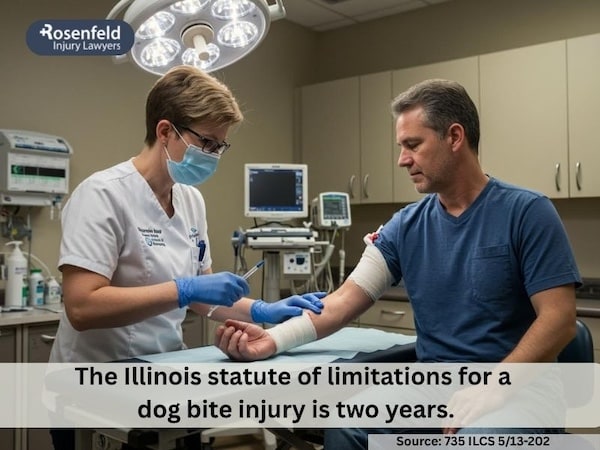
Under 735 ILCS 5/13-202, Illinois law allows victims two years from the date of the dog bite to file a personal injury lawsuit and pursue compensation for their injuries and related losses. Missing that deadline can permanently bar recovery.
For children, 735 ILCS 5/13-211 gives additional protection, and the clock doesn’t start until the child turns 18, allowing them until age 20 to take legal action.
These timelines make it crucial to contact experienced dog bite lawyers as soon as possible after an attack happens, ensuring evidence, witness statements, and all reports are preserved to protect your legal rights.
What Damages Can Victims Recover for Dog Bite Injuries in Illinois?
A serious dog bite or attack injury can leave lasting physical, emotional, and financial scars. The law allows victims to pursue full compensation through a civil claim for the harm they’ve suffered.
Common damages recoverable in dog bite lawsuits include:
- Medical expenses: Medical treatment, emergency room visits, surgeries, rabies shots, antibiotics, physical therapy, and future medical care.
- Lost wages & earning capacity: Compensation for time away from work and any long-term reduction in income.
- Pain and suffering: Recovery for physical injuries, emotional trauma, anxiety, PTSD, and loss of enjoyment of life.
- Disfigurement or scarring: Compensation for permanent scars, nerve damage, or reconstructive surgery following severe and painful injuries.
- Property damage: Replacement of clothing, glasses, or other personal items damaged in the attack.
- Other damages: Depending on the circumstances, a claim may also involve other legally recoverable losses.
How Our Dog Bite Lawyers Can Help
At Chicago Dog Bite Injury Lawyers, we help victims across Illinois understand their legal options after a dog attack. Our team can investigate the incident, gather animal control reports, medical records, and witness statements, and communicate with insurers regarding the claim.
We also help clients prove the full scope of their damages, including medical bills, lost wages, pain and suffering, and future reconstructive procedure costs. Whether the attack occurred in Chicago or anywhere in Illinois, we stand with you through every step of your personal injury claim.
Frequently Asked Questions
No. Illinois does not require a dog to have bitten someone before for liability to arise under 510 ILCS 5/16. The statute focuses on whether the dog attacked, attempted to attack, or injured someone without provocation while the person was peaceably present where they could lawfully be.
Potentially, but a dog bite does not automatically result in jail. Certain violations of the Illinois Animal Control Act can carry criminal penalties. For example, specific post-bite violations can be classified as a Class A misdemeanor for a first violation and a Class 4 felony for subsequent violations.
Illinois law requires a person with knowledge that someone has been bitten by an animal to notify the appropriate animal-control administrator or deputy administrator within 24 hours. The reporting requirement is not limited to severe injuries.
The Illinois Animal Control Act provides a 24-hour reporting period for a person who has knowledge that someone has been bitten. The animal itself also generally must be presented to a licensed veterinarian within 24 hours when the animal is documented to have bitten a person.
The statutory definition is broader than simply the person whose name appears on ownership records. It can include someone who keeps or harbors the animal, has it in their care, acts as its custodian, or knowingly permits the dog to remain on premises they occupy.
Book a Free Consultation for Your Dog Bite Case in Illinois
If you or a loved one was bitten by a dog in Illinois, you don’t have to face the legal process alone. Our Chicago dog bite lawyers offer a free consultation to review your case, explain your rights, and outline your options under the Illinois Animal Control Act.
Our firm operates on a contingency fee basis, meaning you’ll never pay any upfront costs. We only receive a fee if and when we successfully recover compensation for you. Contact us today to speak confidentially with an experienced dog bite lawyer and take the first step toward recovery.
 Legally Reviewed By
Attorney Jonathan Rosenfeld
Content legally reviewed by Jonathan Rosenfeld The information on this page has been legally reviewed by Attorney Jonathan Rosenfeld, founder and managing partner of Rosenfeld Injury Lawyers LLC. With extensive experience representing dog bite victims across Chicago, Mr. Rosenfeld is dedicated to helping injury victims hold negligent dog owners accountable and pursue the maximum compensation available under the law. His deep legal knowledge and commitment to client advocacy ensure that the information provided is accurate, reliable, and aligned with current legal standards.