- Free Case Evaluation: 312-779-6171 Tap Here To Call Us




What is Considered Provoking a Dog?


Don’t Let a Dog Owner Unfairly Blame You for a Dog Attack
After a dog bites someone, the dog owner may argue that the victim provoked the animal. However, the Illinois Animal Control Act is clear about what is considered provoking a dog, and owners have strict liability over their dog’s behavior.
Our Chicago dog bite lawyer team will investigate your case and ensure that you are not unfairly blamed for your own trauma. Contact us today to learn more about what constitutes provocation and explore your legal options.
Provocation as a Defense in Illinois Dog Bite Cases
Illinois is a strict liability state, meaning that dog owners are entirely responsible for their animal’s aggressive behavior (510 ILCS 5/). They are liable for any medical attention, lost income, or disfigurement that results from being bitten. Additionally, they may face repercussions, such as being required to surrender the dog or have it put down.
However, the owner may be released from liability if it can be demonstrated that the pet reacted aggressively in self-defense, either of itself, its puppies, or its owner.
What Behavior Is Legally Considered Provoking a Dog?
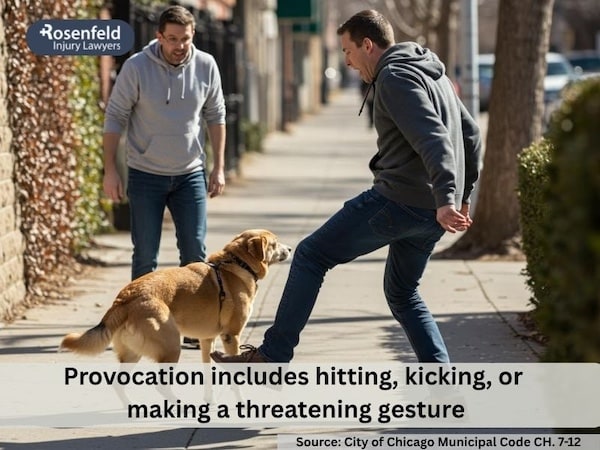
There are only a few circumstances that are considered provoking a dog, including the following (510 ILCS 5/).
- Hitting, kicking, or physically harming the dog.
- Repeatedly teasing the dog, such as pulling on its ears, fur, and tail.
- Cornering or trapping an aggressive dog or one that is in pain.
- Attacking or physically threatening the dog’s owner or puppies.
Actions That Are Generally NOT Considered Provoking
Simply being in a dog’s space is not considered provoking a dog, even if the dog feels threatened. The following actions are not considered provocation.
- Petting a dog that initially seemed friendly.
- Making direct eye contact with a dog.
- Touching the dog, dog’s toys, or dog’s food bowl.
- Accidentally startling a dog, such as by rounding a corner or walking by when it is eating.
- A child reaching through a fence to touch a dog.
- Walking, jogging, or biking past private property without trespassing.
- Visiting the dog’s property with permission from the homeowner.
- Shouting or talking loudly near a dog.
The Burden of Proof Is on the Dog Owner, Not the Victim
In dog bite cases, the injured party does not have to prove that they were not provoking a dog. Rather, the dog owner must provide concrete evidence of provocation. For example, they could show CCTV footage of the person hitting, cornering, or throwing rocks at the dog before being bitten.
Some owners will argue that the person approached their dog in a threatening manner, but this is a circumstantial argument, as what constitutes “threatening” may differ. The court case Kirkham v. Will established the “reasonable dog” standard, which identifies what a reasonable dog would do in certain situations.
For example, if a contractor came to a home, a reasonable dog would not feel threatened or react aggressively, as it would recognize that a new individual is not necessarily a threat. It would only bite if the contractor physically threatened it, such as kicking it away while working. Being near the property, such as a child touching the fence, is also not considered provoking a dog, and surveillance footage can demonstrate that.
As such, the liable party would need to provide proof that the individual harmed the dog, such as through home surveillance footage or impartial witness statements.
How an Illinois Dog Bite Lawyer Fights False Provocation Claims
We fight for dog bite survivors, ensuring they receive the highest possible compensation while holding the dog owner responsible for unprovoked attacks. Our team can assist you with the following tasks:
- Evaluating your damages, including medical bills, lost wages, and emotional distress.
- Conferring with animal behavior experts to show that your injuries are not consistent with a provoked attack.
- Interviewing witnesses about the incident to prove the attack was not justified.
- Reviewing the dog’s medical records to show it was not in discomfort.
- Gathering photos and surveillance footage of the incident.
- Negotiating with the insurance company to ensure your injuries are fully compensated.
- If necessary, filing a court case and representing you before a judge and jury.
Schedule a Free Consultation to Protect Your Rights
The law is clear about what justifies a dog attack, but owners will avoid liability by blaming you. Our award-winning attorneys will aggressively negotiate for fair compensation while protecting you from baseless accusations of threatening behavior.
We work on a contingency fee basis, meaning there is no risk to hiring our services: no fee unless you win. Call us today for a free consultation about your rights.
Content reviewed by Chicago dog bite lawyer Jonathan Rosenfeld of Rosenfeld Injury Lawyers LLC, who hold dog owners accountable to secure compensation for injured victims and their families, and is a trial lawyer recognized by Super Lawyers, the American Association of Justice, and Million Dollar Advocates for serious crash cases across Illinois.