- Free Case Evaluation: 312-779-6171 Tap Here To Call Us




US Dog Bite Statistics


Across the country, US dog bite statistics reveal a persistent public-health and legal issue affecting both dog owners and victims. Each year, millions of people suffer serious dog bite injuries serious that need emergency care, from minor wounds to severe lacerations requiring reconstructive surgery.
These incidents lead to countless dog bite claims, highlight the need for stronger prevention efforts, and underscore the importance of responsible ownership, education, and awareness to prevent dog bites nationwide.

How Many Dog Attacks Occur in the US Each Year?
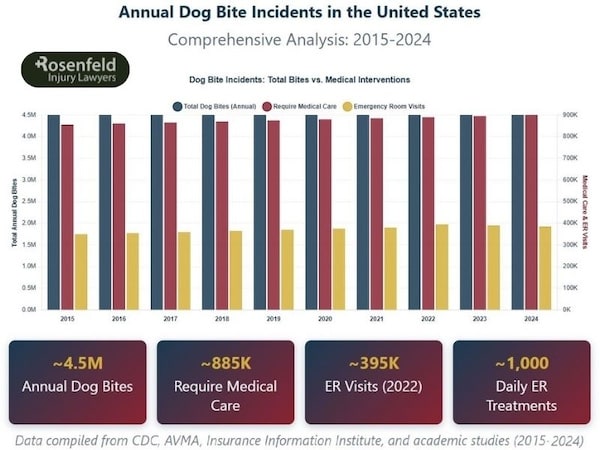
Research shows that an estimated 4.5 million Americans are bitten by dogs annually. Around 337,000 dog bite injuries require hospital emergency department visits each year and nearly 27,000 victims need reconstructive surgery.
Most victims are bitten by dogs they know (around 60%), often a family dog or neighbor’s pet. In fact, about 80% of dog bite incidents occur at home or on private property.
Children represent the most vulnerable age groups: those aged 5 to 9 years experience the highest rate of emergency-care treatment, and their injuries most often affect the face and scalp, requiring intensive emergency care.
About half of all children aged 12 and under have been bitten by a dog at least once in their lives. Among common childhood injuries, such as those caused by sports, playground activities, or bicycles, dog bites rank second in annual emergency department visits.
Adults, especially delivery drivers and postal workers, also face elevated risk. The U.S. Postal Service (USPS) reported more than 6,000 dog attacks on mail carriers in 2024, including 344 incidents in Illinois alone.
Even though not every dog bite results in litigation or an insurance claim, the aggregate toll on hospital emergency departments, local animal care and control agencies, and public-health resources is enormous. Each case represents a person forced to seek medical attention for infection, trauma, or scarring after being attacked by unfamiliar dogs, stray dogs, or chained dogs.
What Are the US Statistics on Dog Bite Fatalities?
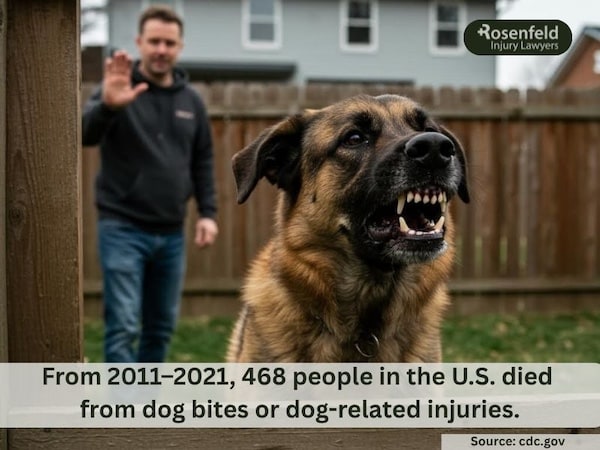
While most dog bites are non-fatal, data on fatal dog attacks show troubling patterns. From 2011 to 2021, the U.S. Centers for Disease Control and Prevention (CDC) recorded 468 deaths from being bitten or struck by a dog, an average of 43 dog bite-related fatalities per year.
During the first half of this period (2011-2016) more males than females died from such attacks, but from 2017-2021 deaths among females exceeded those among males.
In 2021 alone, there were 81 deaths, the highest number recorded that decade. Independent reporting documented 98 fatal dog attacks in 2022, more than doubling the 2019 total.
The most vulnerable dog bite fatality victims are either young children or older adults, groups less able to defend themselves or seek medical care immediately. Multiple dogs are sometimes involved in fatal attacks, and many dog bite fatalities feature dogs that escaped fencing or had a history of aggression, but this data is typically not officially recorded, so reporting is unreliable.
According to research, breed identification in fatal dog bite statistics is unreliable: in studies comparing reports, breed determination was accurate for only 17.6% of cases, reinforcing that risk factors such as owner behavior, management, and environment, not certain breeds, determine outcomes.
Studies of fatal dog attacks note that mixed breed dogs and large other dog breed categories are often represented among the dogs involved, but official breed data remain incomplete. Researchers emphasize that other breeds and even other dog types not typically viewed as aggressive can still cause severe harm when unsupervised.
Dog Bite Force Statistics
Scientific measurements confirm that domestic dogs can exert jaw pressures strong enough to crush bone and cause severe tissue damage.
Experimental in-vivo testing recorded bite forces ranging from 147 N to 926 N at the canine teeth and up to 3,417 N at the molars, depending on skull size and musculature. Converted to standard pressure units, these values correspond to roughly 150 – 450 PSI, though results vary by methodology.
For comparison, a human bite averages about 120 – 160 PSI, demonstrating that even medium-sized dogs can inflict significantly higher force. Biomechanical analyses show that bite strength correlates with skull shape and body mass, not breed aggression. Dogs with broader zygomatic arches and shorter muzzles typically generate the highest pressures.
Injury data on dog bite wounds support these findings: bite pressures above 300 PSI are capable of penetrating muscle, fracturing bone, and producing complex dog bite injuries that often require reconstructive surgery or emergency care. Such force levels help explain why victims of severe bites frequently experience extensive tissue destruction and long-term complications.
Dog Bite Injury Statistics
Recent national data show that dog bite injuries remain a major cause of emergency-department visits across the United States. The data showed an average of 337,000 dog-bite–related ED visits each year, most often involving the arms and hands (47%), head and neck (27%), and legs (21%). Adults are more likely to suffer arm or hand wounds, while children under 10 most often sustain facial or scalp injuries, which require more complex medical treatment.
According to the American Society of Plastic Surgeons, surgeons performed over 19,200 reconstructive procedures for dog bites in 2023, reflecting the frequency of deep lacerations, nerve damage, and tissue loss that demand surgical repair.
Hospitalization analyses by the Agency for Healthcare Research and Quality show an average inpatient cost exceeding $18,000 and a 3-day stay, significantly higher than most other injury admissions. Victims sustaining multiple anatomical locations of injury experience higher complication rates and longer recovery times.
Infection remains a leading complication, with risk highest in hand and deep puncture wounds. Guidelines recommend antibiotic prophylaxis and timely rabies post-exposure treatment when indicated.
Overall, dog bite incidents disproportionately impact children and males, occur mainly at home or on private property, and frequently involve known or family dogs, patterns emphasizing the need for supervision and early medical care to reduce severe outcomes.
How Much Can Victims Recover in Dog Bite Cases?
According to the Insurance Information Institute (III), U.S. insurers paid about $1.57 billion for 22,658 dog-related injury claims in 2024, with an average payout of $69,272 per claim, up from $58,545 in 2023. The average cost per claim has surged 86% since 2015, driven by escalating medical care costs, reconstructive procedures, and higher verdicts for severe dog bite injuries.
Insurance experts note that claims involving children, delivery workers, or multiple anatomical locations of injury tend to result in the largest settlements due to the long-term effects of scarring, nerve damage, and psychological trauma. Many victims recover compensation for medical bills, lost income, emotional distress, and permanent disfigurement.
These statistics show that compensation for dog attack incidents continues to rise nationwide as both the frequency and severity of claims increase. Even a single attack can result in substantial financial recovery through homeowners or renters insurance, or through civil lawsuits against negligent owners when coverage is denied or inadequate.
Nationwide Dog Bite Prevention Efforts
Across the country, federal and state agencies have launched coordinated programs to prevent dog bites through education, vaccination, and responsible ownership.
The U.S. Centers for Disease Control and Prevention (CDC) promotes national safety guidance in its Healthy Pets, Healthy People initiative, offering tips on supervision, socialization, and rabies prevention. The CDC also emphasizes a community approach to the prevention of dog bites, encouraging partnerships among public-health departments, veterinarians, and animal care and control officials.
In Illinois, the Animal Control Act (510 ILCS 5) requires that any dog bite incidents be reported to local health authorities. Biting dogs must undergo a 10-day observation period to rule out rabies, and owners face strict liability for unprovoked attacks. Local counties reinforce these rules through public education and programs designed to prevent dog bites.
Together, federal outreach and state enforcement help reduce dog bite injuries, encourage responsible pet ownership, and promote safer communities for both people and dogs.
FAQs
How many dogs does the American Veterinary Medical Association report?
The AVMA estimates that there are about 89.7 million dogs living in the United States, with roughly 62 million households owning at least one. As more families bring pets into their homes, the potential for dog attack incidents increases, making education and responsible ownership essential to preventing dog bites.
What are the most aggressive dog breeds?
Experts caution that breed alone does not determine aggression. While studies sometimes associate aggressive dog breeds like Pit Bulls, German Shepherds, and Rottweilers with a higher number of severe dog bite injuries, the AVMA emphasizes that the behavior of the owner, socialization, and environment are far stronger predictors of aggression than breed. Responsible ownership, training, and supervision remain the most effective ways to prevent dog bite fatalities across all dog breeds.
Free Consultations on Dog-Bite Related Injuries
If you or a loved one has been injured in a dog attack, our experienced dog attack attorneys in Chicago are here to help. We represent dog bite victims across Illinois and nationwide, guiding clients through every step of their legal recovery. Our firm offers a free consultation to review your case, explain your rights, and outline the best options for pursuing compensation.
We handle every case on a contingency fee basis, meaning you pay no upfront costs and no attorney fees unless we win your case. From negotiating with insurance companies to filing lawsuits against negligent owners, our team works tirelessly to recover damages for medical care, lost income, and emotional distress.
If you’ve suffered from a dog bite injury or dog bite related attack, don’t wait to seek help. Contact us today for a free and confidential consultation with our compassionate team.
Content reviewed by Chicago dog bite lawyer Jonathan Rosenfeld of Rosenfeld Injury Lawyers LLC, who hold dog owners accountable to secure compensation for injured victims and their families, and is a trial lawyer recognized by Super Lawyers, the American Association of Justice, and Million Dollar Advocates for serious crash cases across Illinois.